Search This Blog

08 November 2023

Road reforms 1997 and environmental costs of roads


The editorial of The Dominion 15 October 1997 reports that full user pays is on its way, following the report of the Roading Advisory Group (RAG). The RAG conclusions were that the system needed more than minor reforms, nor should it simply have more money spent on it, but also it did not support privatising the roads.  It recommended retaining open access to roads but with user pays. It included ending ratepayer funding for roads, but retaining ratepayer funding of footpaths and cycleways. The editorial mentioned the use of technology to enable road pricing, but also called for an end to direction of some fuel taxes to the Crown account.

Following this report, the Bolger/Shipley Government advanced road reform proposals titled "Better Transport Better Roads", which was to commercialise road management and empower commercial road managers to implement road pricing.  However, these were cancelled by the Clark Government after the 1999 election. There reforms have not been revisited by subsequent governments to date.

 The subsequent two newspaper reports reflect work undertaken by the Ministry of Transport on the environmental impacts of roads. It was one of a series of papers from the Land Transport Pricing Study on environmental externalities. The report estimated costs were between $1b and $4b, with the best estimate being $1.38b per annum.. The main issue being how to separate externalities from costs born privately.  Noise was estimated to cost between $230m and $2.65b, with best estimates being $290m. Water impacts was estimated to cost between $35m and $170m, with best estimates being $100m. Greenhouse gases estimated to cost between $25m and $580m with best estimates being $290m.  The conclusion was that the report helped to indicate what policy responses might be appropriate to externalities. Since that report, two further reports have been prepared which include assessment of the environmental costs of transport, namely Surface Transport Costs and Charges (2002) and Domestic Transport Costs and Charges (2023).

The Independent 29/03/96


Evening Post 30/03/96

03 November 2023

In Transit - April 1996 No. 72 - Trialling salt on the Desert Road - lowest quarterly road toll since 1979

 The April 1996 edition of In Transit included the following articles:

  • Transit NZ trialling use of salt on the Desert Rd (SH1) over winter to keep it open from ice
  • New approval process for National Roading Programme released by Transfund Establishment Board. This approves road maintenance and passenger transport subsidies first, before approving capital spending, advisory, audit and contract management funding.
  • Testing of the SH1 Wellington Thorndon Motorway viaduct earthquake strengthening proves refit significantly improved its resilience against a major earthquake.
  • First quarter road toll for 1996 lowest since 1979, attributed to safety advertising, increased enforcement and safety audit/black spot investigations on the road network.
  • Report published on the engineering challenges of building the Transmission Gully motorway, which were substantial, although no decisions had yet been made on the preferred route.
  • Roadside interviews carried out of motorists about their trip patterns.


02 November 2023

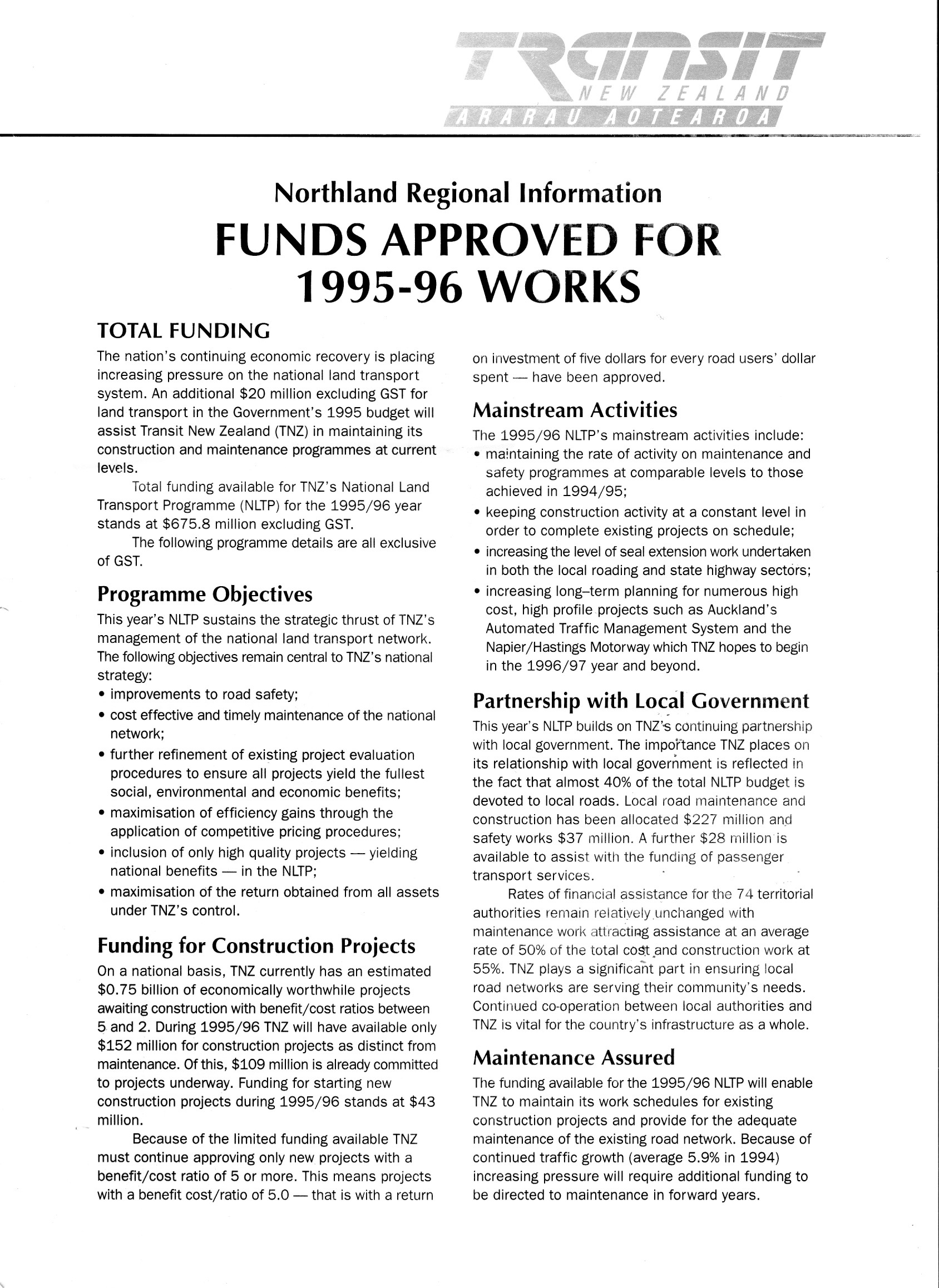
National Land Transport Programme 1996 - Northland newsletter


National Land Transport Programme 1996 National funding

National Land Transport Programme 1996 Northland summary

National Land Transport Programme 1996 Northland summary allocations


National Land Transport Programme 1996 Northland Local Roads funding


National Land Transport Programme 1996 Northland State Highway funding


A few months ago I posted the newsletters for other regions for the 1996 National Land Transport Programme (see Auckland, Wellington, Waikato, Gisborne/Hawke's Bay, Taranaki/Manawatu,  Canterbury, Otago/Southland), this is the newsletter for Northland region.

$50.4m was allocated to the region for the year, 47% of funding was provided to local roads, 52% to state highways and the remainder to public transport and administration (public transport being almost entirely funding paratransit services).

Key projects noted were:
  • Funding to complete sealing of SH12 through Waipoua, as the last portion of state highway in Northland that was unsealed
  • 82km of local roads in Far North District were sealed in the previous year, the programme continued into the following year with 24 new seal extension projects
  • Nine new seal extension projects on local roads in Whangarei District
  • Realignment of SH1 north of Hukerenui
  • Urlich Hill relignment on SH10
  • Brynderwyn North widening on SH1
  • Kamo Bypass design

31 October 2023

In Transit - February 1996 - Set up of Transfund

The February 1996 issue of In Transit newsletter led with announcement of the Transfund New Zealand Establishment Board to set up Transfund New Zealand later in that year. Transfund would take over the land transport funding function from Transit New Zealand (leaving Transit New Zealand's sole function as the state highway manager).  This functional separation was undertaken in the second term of the Bolger Government, but would be reversed in the third term of the Clark Government in 2008.

Other stories in this newsletter include:

  • Realignment of a flood prone section of SH7 west of Hammer
  • Start of a project to seal 23km of Far North District roads north of the Hokianga, funded 62% by Transit New Zealand. This reflected a revision to project evaluation procedures that increased the value of sealing roads. It was noted that at the time 77% of roads (by distance) in the Far North District were unsealed.
  • A five-fold increase in logging expected in Northland by 2005 following a survey of local timber companies.
  • A survey of Transit's performance sent to local authorities and consultants.
  • Near completion of the Pott's Hill realignment on SH57 north of Levin, at a cost of $2.1m.  This realigned a previously dangerous and winding section of highway.
  • Project audits of 15 projects indicated 13 out of the 15 met or exceeded the funding cutoff of a BCR off 5. 
  • Sponsored roadside toilets.
  • Moves to ensure speed advisory signs (applied to approaching corners) are applied more consistently, so drivers can respond to them more appropriately.


26 October 2023

Karori bus lane and Karori Tunnel centenary and possible duplication

Wellington's suburb of Karori has two routes out towards the city, one via Kelburn and down Aro Valley, and another through the Karori Tunnel opened in 1900. The population of Karori at the time was 1,100, today it is around 17,000 people.  A tram line was extended through the tunnel in 1907, but replaced with trolley buses in 1954. There have been various proposals to build a second Karori Tunnel to the south or north of the current tunnel, removing the Glenmore Street hairpin curve, or to connect to Aro Street, but none proceeded far.


The first article is from 1996 when the idea of a bus lane approaching the Karori Tunnel was first floated, and in 1997 Wellington City Council formally proposes the Chaytor Street bus lane approaching from the west.  The feasibility study indicated congestion added 20 minutes to the bus trip from Karori Park to Karori Tunnel in the AM peak.  The cost of the project was estimated at $450,000 with a BCR of 22:1.  The lane proposed was along parts of Karori Road (those sections would not proceed).  The lane was subsequently built, but is now proposed to be removed to make way for an uphill cycling lane.

The last article commemorates the centenary of the Karori Tunnel. Notably it indicates that a second Karori Tunnel is "scheduled" to be built within the next decade (i.e. by 2010) to run parallel to the existing tunnel, and could probably be funded by tolls. It was then estimated to cost $30-40m.  It was noted it was a major bottleneck but traffic lights would not be installed (traffic lights have subsequently been installed to manage bus traffic through the narrow tunnel).

In 2023 there is no second Karori Tunnel being pursued by Wellington City Council.

23 October 2023

Wellington traffic congestion in 1988 and proposed funding reforms

In 1988 the Dominion ran a major story about traffic congestion in Wellington which reviewed what might be done about it.  It followed on from proposals from Minister Bill Jefferies to combine road and public transport funding and also reflected the view at the time that the future for Wellington transport was not to seek to respond entirely to the growth in car traffic. It noted at the time that 42% of commuters to central Wellington travelled by public transport.  At the time buses in Wellington were provided by Wellington City Transport, which was a WCC owned monopoly, and in the Hutt/Porirua and Kapiti most bus services were provided by Cityline (NZR Road Services), noting that the Ministry of Transport had proposed opening up bus services to competition. 

It was noted that public transport had to be made more attractive, but it was also claimed that within two years (1990) the motorway extension from the Terrace Tunnel to Mt Victoria Tunnel would be started as it was the "highest priority" road project in the Wellington region, following completion of the Mungavin Interchange on SH1 at Porirua.  Of course, the motorway extension did not proceed following the land transport funding and governance reforms of 1989, and the significant cut in funding provided in 1991 that saw the project fail to meet the funding threshold.  The WCC's analysis also suggested a second Terrace Tunnel had good economic benefits but this was seen as a "low priority" regionally (under a funding model that relied on local authorities in the region agreeing on priority projects. 

Ultimately this story was inconclusive, and there would be future articles highlighting the lack of progress in addressing congestion in Wellington.


The article notes the Greater Wellington Land use and Transportation Strategic Review that would also consider whether Transmission Gully would be worth pursuing, but at the time the Transmission Gully proposal was meant to end at Belmont in the Hutt on SH2, which was seen to be adding significantly to congestion on SH2 more generally.  Transmission Gully would be revised in the 1990s to connect to SH1 first at Takapu Road Tawa and later at its current location.  Congestion pricing (called road tolls) was not being considered seriously. 


The article below notes that afternoon accidents cause more congestion than morning ones, but that severe congestion results in few serious accidents because slow traffic causes only minor collisions. Another article confirms Minister Bill Jefferies wanting land transport funding to include public transport, and for motorists to also fund road safety education and enforcement.  MoT had also proposed opening up profitable public transport routes to competition and requiring competitive tendering for subsidised routes (which was ultimately implemented).  Noting that public transport recovers 50-55% of operating costs from fares, with the remainder split between central and local government.  A short article notes the Hutt City Mayor of the time wanting more Wellington offices to relocate to Lower Hutt.  

Overall the conclusions were very open ended. While the motorway extension was expected to make a difference, overall the focus was on changes to the funding system and considering how to make public transport more competitive with driving.

20 October 2023

Courtenay Place upgrade 1996


Given the soon to begin "Golden Mile" works along the route from Courtenay Place along to Lambton Quay in Wellington, this article from 1996 for the last major upgrade of Courtenay Place may be timely.  The works consisted of:

  • Simplification of the intersection between Courtenay Place, Kent/Cambridge Tce and Majoribanks St
  • Removal of the two "island" bus stops, replaced with side located stops (associated also with the redesign of many Wellington bus routes to be through routes between suburbs, rather than services from Western and Northern suburbs terminating at Courtenay Place)
  • New footpaths and a large pedestrian area on the south-eastern end of Courtenay Place, with significant narrowing of the loadspace to enable wider footpaths.
The old island bus stops while providing free flow conditions for buses moving east along Courtenay Place, were also considered a hazard to pedestrians, due to the tendency of some unsociable and intoxicated people to reside in the shelters, frightening some bus passengers. The new design opened up Courtenay Place more generally, although the angled parking at the south-eastern end was removed some years later.

The total project cost around $2m in 1996.