Search This Blog

Showing posts with label 1997. Show all posts

18 October 2024

In Transit - December 1997/January 1998 - No. 87 - Installation of skid retardant surface near Petone

This edition of In Transit, highlights the successful installation of a new skid retardant surface under the Petone over bridge on SH2 near Wellington.  The new surface was credited with a 100% drop in crashes over seven months.  The new product, called Safe Grip, created 40% more friction.

Other stories in this edition include:

  • Photos depicting the installation of the overbridge at the Newlands Interchange on SH1 in Wellington 
  • Photo of turning the sod on the Pakowhai to Hastings section of the "Hawke's Bay Motorway" (now called the Hawke's Bay Expressway noting it is one lane each way).
  • List of roadworks underway over Christmas/New Year.
  • Presentation from Malaysia about privatising the countries toll road network.


14 October 2024

In Transit - November 1997 - No. 86 - Summary of construction work commencing that summer


With the uplift in funding over the previous two years (lowering the benefit/cost ratio threshold of land transport funding capital works from 5 to 4.5 to 4:1), this edition of In Transit focused mostly on the construction work continuing and starting around the country at the end of 1997.  Perhaps what may be of interest today is the relatively modest price of so much construction work at the time, as even taking into account inflation (CPI) prices would be much more than the 88% increase since then, today.  Even on wage inflation of x 2.49, the costs of construction look modest. 

Key projects underway were:

  • ALPURT (Albany-Silverdale extension of the Northern Motorway) enabling works, with opening expected in 2000 (and the whole route to Puhoi by 2002, which did not happen as funding priorities were changed following the change of government in 1999, seeing work terminate for several years at Orewa - and the Puhoi segment redesigned into a higher quality route and made into the first toll road under the Land Transport Management Act).  Budget at the time for the whole project was $175m
  • Orewa bridge replacement (to be open February 1998).
  • Te Here curves realignment, SH1 Waikato to be completed March 1998 ($750k)
  • Napier-Hastings motorway extension (which did not become a legal motorway but rather classified as expressway). Essentially a two-lane limited access highway built from Pakowhai to Hastings along the long standing Hawke's Bay motorway corridor protected since the 1960s. Including the Ngaruroro River Bridge, the cost was $10.3m, and was described as the largest single road project in the region since the Runanga Deviation on SH5 in the late 1960s.  This provided a direct faster route from Napier to Hastings, especially as Omaha Road is adjacent to the main Hawke's Bay regional hospital. It was a 7.7km new road with a 323m bridge.
  • Vinegar Hill realignment SH1 near Hunterville, at $5.8m. Includes 4.4km of new highway.
  • Laws Hill realignment SH57 near Shannon at $3.5m, includes 2.5km of new highway and passing lane.
  • Newlands Interchange Wellington SH1, at $17m
  • Stoke Bypass Nelson SH6, at $26.2m including 7km of new road including grade separation and passing lanes.
  • Otira Viaduct SH73 at $25m.
  • Hawks Crag rock clearance SH6 Buller Gorge
  • Tumai Realignment SH1 north of Dunedin at $2.8m, including 2.5km of realignment and a 800m passing lane
  • Gorge Creek bluffs realignment SH8 between Alexandra and Roxburgh at $650k
Also mentioned is a sample of rough textured stone use for sealing road in Hawke's Bay to improve skid resistance and Transit's support for a speed enforcement campaign.


04 October 2024

In Transit - September 1997 - No. 84 - National State Highway Strategy Released - Transit's proposal for road reform

The September 1997 issue of In Transit focused on the release of the draft National State Highway Strategy which was intended to outline the vision, goals and objectives for its management of the state highway system. The overarching vision was to "provide road users with safe and efficient state highway solutions", with four goals around safety, efficient, quality service and avoid or mitigating adverse environmental effects.  It included some specific goals including upgrading urban highways in main cities, such as four-laning rural corridors around Auckland, Hamilton, Tauranga and Wellington, building additional passing lanes and improving existing road alignments. The draft strategy was subject to a three month consultation.

Perhaps of greater interest are two smaller articles with an eye to reform of the sector.

The first, titled "Roading lessons from past point to future" noted that a 1953 report called the "Report of the Roading Investigation Committee" covered issued still valid in 1997. This included that road traffic was national in character and that the burden of paying for roads should shift from ratepayers to road users. The 1953 report recommended that the importance of a national network should be recognised. The report resulted in the National Roads Board being created.

The second titled "Transit calls for one company to provide all roads" was a note of Transit New Zealand's submission to the Ministry of Transport discussion paper "Land Transport Pricing Study : Options for the Future".  It proposed that the Government form a single road company to manage the entire national road network (including local roads). It would not be an enlarged Transit New Zealand (although it is hard to anticipate it wouldn't look like that) but a joint central and local government formed entity.

Transit New Zealand proposed the new company could charge road users directly, go into partnerships with the private sector and borrow money, and move away from government dependency for funding of roads. It included not imposing a cost of capital charge on existing roads (but implies new ones could) contracting out speed and overweight vehicle enforcement. and replace fuel tax. It also proposed that rates be replaced with a "property access charge" to reflect the contribution of road access to the value of a property. The intention being that all road users face the economic costs of their decisions.

In 2024, given the Government of the day wishes to replace fuel tax, it is interesting to consider how this was being considered by the state highway agency nearly 30 years earlier!

Other points in this edition include:

  • Image of the construction of the Newlands Interchange, SH1 Wellington
  • A symposium promoting greater use of cycling in urban areas and how that can be encouraged
  • Image of a Kiwi Crossing sign on SH73 near Arthurs Pass
  • Road Engineering Association of Asia and Australasia presenter to discuss keeping roads open in winter
  • Photo of a delegation from the US Federal Highway Administration visiting New Zealand


01 October 2024

1997/98 National Roading Programme : Transfund News June/July 1997 No.5 and In Transit July 1997 No.82


This post contains both the Transfund and Transit NZ newsletters focused on the 1997/1998 National Roading Programme, the second National Roading Programme released by Transfund.  The key point was that the funding threshold for capital works had been lowered from a BCR of 4.5/1 to 4/1 (it had been 5/1 for some years before then). This saw $829.2m (exc.GST) being spent in that year.  This saw a 20% increase in road construction. Main construction projects funded included:

  • Widening Auckland's Northern Motorway northbound from Onewa Rd to Esmonde Rd
  • Albany-Puhoi realignment (Albany-Silverdale-Orewa section)
  • Realignment of SH26 Platts Rd, Waikato District
  • Realignment of SH5 Stockpile curves, Rotorua District
  • Realignment of SH33 Maungarangi S bends, Western BOP District
  • SH1 deviation Taihape
  • Ngaere Overbridge realignment SH3, Stratford District
  • Plimmerton-Pukerua Bay realignment and four laning, SH1 Wellington
  • Realignment Sloans-Tumai, SH1, Otago
  • Stoke Bypass construction SH6
  • Khyber Pass, Symonds St, Newton St intersection upgrade, Auckland City
  • Mt Eden/Balmoral intersection upgrade, Auckland City
  • ALPURT-Orewa Link Road, Rodney District
  • Stage 2 Glenorchy Rd seal extension ,Queenstown-Lakes District
  • Southern Catlins Scenic Route seal extension, Clutha District
Also of note were modest increases in maintenance funding for local roads and state highways, continuation of similar funding for public transport subsidies, and funding for investigation and design works on several major projects notably:
  • Kopu Bridge replacement SH25
  • East Tamaki Corridor Arterial, Manukau City (later built as Te Irirangi Drive)
  • R1 Arterial Hamilton City (later built as Wairere Drive)
  • Kapiti Sandhills Arterial (later cancelled in favour of the Kapiti Expressway on a similar alignment)
It was noted that passenger transport funding was up 25% in Gisborne/Hawke's Bay, 14% in Manawatu/Wanganui/Taranaki and 9.6% in Otago/Southland. 

A separate leaflet on the new structure for Transfund New Zealand was also published (see below)

The In-Transit newsletter focused understandably on the state highway projects. Besides the projects listed above, it also noted funding to improve the Taupo northern access, the Vinegar Hill realignment at SH1/SH54 intersection in Rangitikei District and the widening of seven one-lane bridges on SH6 in Queenstown/Lakes District, as one bridge on SH94.  

Other articles in the In Transit newsletter noted:
  • Development of modelling of traffic flows;
  • Continuing construction of the SH16 Rosebank-Patiki Interchange on Auckland's North-Western Motorway (providing east bound off and on ramps to pair with the westbound ones that had long existed). 


18 September 2024

In Transit - February 1997 - No. 78 - Focus on repairs after Cyclones Fergus and Drena


In NZ, emergency works were always not too far away as part of the portfolio of works for road networks.  In February 1997, Cyclones Fergus and Drena caused extensive damage mainly in the Coromandel District.  The feature article highlights the cost of $5.8m (1997 prices) to fix the damage on SH25 and SH2, but also damage on SH1 (Brynderwyns), SH35 and SH88.

Other stories include:
  • Review of Special Purpose Roads: Special Purpose Roads were a category of local road that were subject to higher Financial Assistance Rate funding (typically 75%) from the National Roading Programme compared to other local roads (which obtain typically 50%). Such roads get higher funding because of a high proportion of tourist traffic, be below state highway standard and pass by properties with rating potential much lower than the costs of maintaining the road.  Curiously, this decision has mostly funding implications, yet was being carried out by Transit New Zealand which was no longer the funding agency, as Transfund New Zealand had been formed the previous year. 
  • Declaration of the revoked section of SH38 as a Special Purpose Road: As part of the State Highway Review in 1995, Transit New Zealand revoked SH38 between Te Whaiti and Ruatahuna. Transit announced it had decided to classify it as a Special Purpose Road increasing the funding to 75% of maintenance costs. That section of road was not sealed at the time. 
  • Earthquake strengthening of Thorndon Overbridge of the Wellington Urban Motorway: Image provided of the work to strengthen the 72 concrete columns supporting the Wellington Urban Motorway from the harbour over the Ferry Terminal, railway yards, Thorndon Quay. 
  • Briefing to the incoming Minister of Transport - Jenny Shipley indicates critical traffic levels in Auckland: This noted that traffic on Auckland Harbour Bridge had increased 20% between 1989 and 1997, and on the Northern Motorway south of Albany (when at this time it terminated), it had doubled from 1989 to 1995.  It noted work was underway investigating and consulting on various major projects included:
    • SH1 Albany-Puhoi (built in two stages)
    • SH1 Harbour Bridge approaches (subsequently cancelled in favour of the Victoria Park Tunnel)
    • SH18 Greenhithe Bypass (built as part of the Upper Harbour Motorway)
    • SH18 Hobsonville Bypass (built as part of the Upper Harbour Motorway)
    • SH20 extension to Richardson Road (built)
    • SH20 extension to SH1 south (built)
    • Bus only lanes on Northern Motorway (partially replaced with Northern Busway)
  • Transit NZ winning the Institution of Professional Engineers New Zealand (IPENZ) environmental award: For the upgrade of SH12 through Waipoua Forest.


19 January 2024

1997: Interview with Transfund NZ Chair in Opus newsletter

In June/July 1997, Opus Consultants (the new name for Works Consultancy, the former Minister of Works and Development's consultancy arm after it had been privatised) produced its Momentum newsletter, which included an interview with then Transfund NZ Chairman Michael Gross.  The key points were:
  • Establishment of Transfund was central to a wider range of reforms of the roading system.
  • NZ's road network was seen as a model of change internationally by the World Bank
  • Setting up of Transfund is expected to make the system more efficient by assisting development and co-ordination of national and regional strategies.  It operates like a private company, with the security of revenue to develop long-term strategic solutions.
  • Gross said despite recent increases in funding (enabling the BCR for funding to drop to 4), the system is still underfunded.
  • NZ has a low capital/high maintenance road system meaning roads have relatively short lives, and Transfund is looking how to optimise this.
  • Alternatives to roading funding is to find ways to overcome the distortions of existing means of charging for road use, which doesn't address externalities such as congestion, environmental degradation and social dislocation.  Options it could fund include barging logs instead of massive road upgrades or new passenger transport systems to avoid building new road capacity, but is unlikely to provide funds for large projects like light rail.
  • The forthcoming Road Pricing Study is expected to document options for road pricing and the need for decisions.  Options include congestion charging, suggesting use of smart card technology, and replacement of rats with some form of access charge for properties to access the road corridor, with registration covering the right to use the network.
  • Gross thought a purely commercial model would be difficult to apply and need effort to ensure lightly trafficked rural roads were adequately funded, as urban areas generate far more income than the costs of maintaining those roads.
Momentum June/July 1997 - interview with Michael Gross


13 November 2023

Wellington traffic and transport funding woes in the 1990s

This post is a series of articles from 1990 through to 1999 discussing the issues and funding of roads and urban transport more generally in Wellington.


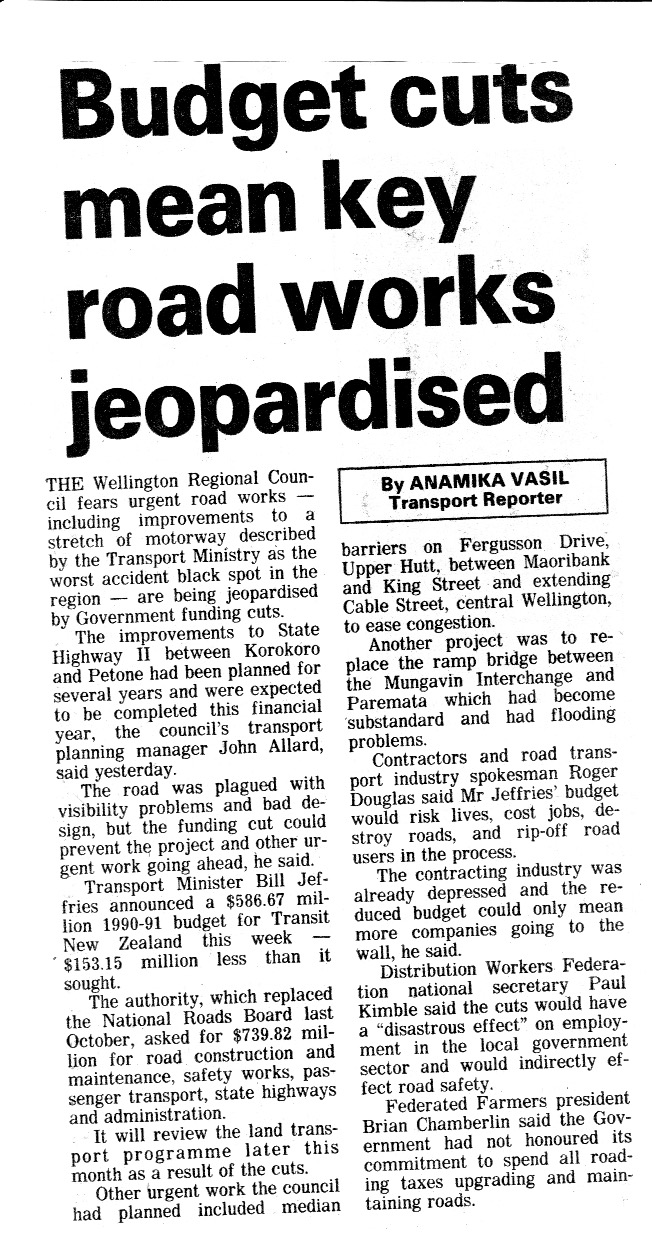
This article from 1990 reflects the cuts in funding in the last budget under the Fourth Labour Government, at the time under Geoffrey Palmer, which provided $153m less funding that Transit New Zealand sought.  Projects threatened (and delayed) were:

  • Korokoro/Petone upgrade to SH2 (which was not undertaken until the late 1990s)
  • Fergusson Drive median barriers Upper Hutt City (which did not proceed)
  • Cable Street extension Wellington (which did proceed to create the one-way system with Wakefield Street)
  • Ramp Bridge replacement Porirua, SH1 (which proceeded in the late 1990s.


This feature by Kate Coughlan in The Dominion describes the major traffic problems in Wellington in the 1990s.  It concludes that there is unlikely to be any significant relief. It summarises some of the issues of driving in the morning peak and follow by a map with traffic figures describing the main choke points. 


This summary is a fair report of the key traffic bottlenecks across the region in 1996.  To review where these now are in 2013:
  • Paremata-Pukerua Bay: The proposed solution at the time was implemented, with a second Paremata Bridge, clearways, traffic lights through to Plimmerton and four-laning through Plimmerton.  This relieved congestion at this location, but Pukerua Bay became the major bottleneck. This was addressed long-term with the Transmission Gully motorway, although the forecast it would be open by 2006 proved to be more than a decade out.
  • SH2:  In 1996 the problems were the intersections at Korokoro and Melling. The best solution mooted was the Cross Valley Link (which has not yet been built), but the proposed solution was grade separation at Korokoro, Dowse Drive and Melling.  Korokoro and Dowse Drive were built in the early 2000s, but Melling although funded is yet to commence construction.  In 2023, Melling remains a major bottleneck, but north of Manor Park, SH2 is particularly slow in the AM peak.
  • Mungavin Avenue: In 1996, the Mungavin Roundabout queued back to Cannons Creek. As reported, the solution was a duplicate Mungavin Bridge, which was built in 1998 and addressed the bottleneck.
  • Newlands lights:  The busiest traffic light controlled intersection on SH1 was a major bottleneck, but as reported, the Newlands Interchange had been funded and would permanently relieve this bottleneck. 
  • Wellington city motorway offramps: Not specific on the ramps, but noted that policy was to discourage car commuting into the CBD, and encourage public transport use by sustaining subsidies for rail and bus services.  This appears largely to have succeeded as traffic to the Wellington CBD in the AM peak has been flat for over 20 years.
  • Karori Road:  The Karori Tunnel and Karori Road were bottlenecks with very slow traffic at the time and this has not changed. The best solution at the time was said to be to widen Karori Road and duplicate the tunnel, but the expected solution was a bus lane.  The outcome was the Chaytor Street bus lane, which is soon to be removed to accommodate an uphill cycle lane under Let's Get Wellington Moving.  Karori Tunnel remains a bottleneck.
  • Mt Victoria Tunnel/Basin Reserve:  The 1996 bottleneck was traffic exiting Mt Victoria Tunnel to the Basin Reserve, and from Adelaide Road. The preferred solution was grade-separation at the Basin Reserve, but planned solution was traffic signals. In 2023, the Basin Reserve is a major bottleneck, as is the tunnel. 
  • Terrace Tunnel to Mt Victoria Tunnel: Congestion between the two tunnels was chronic in the 1990s with the dog-leg route between the tunnels.  The preferred solution was to duplicate the tunnels and connect them with the proposed cut-and-cover motorway extension. However, what was expected was the "Inner City Bypass" of Karo Drive with a one-way system. This was expected to be completed by 2000, but did not finish until 2007.  In 2023, the two tunnels are major bottlenecks, and Vivian Street/Karo Drive are regularly congested at peak times.
  • The Merge (SH2/SH1 Ngauranga): This was described as caused by incompetent driving and the solution was Police presence at the site encouraging better behaviour.  In 2023, the issue remains although northbound in the PM peak, the addition of a fourth lane from Aotea Quay has greatly eased congestion in that direction.
Evening Post 25 June 1996

Meanwhile, the Business Roundtable believed that the time was right to end public transport subsidies, and that the Wellington Regional Council should progressively reduce such subsidies and ensure services paid their own way, and allow more bus services to compete with rail. These proposals were not taken up.


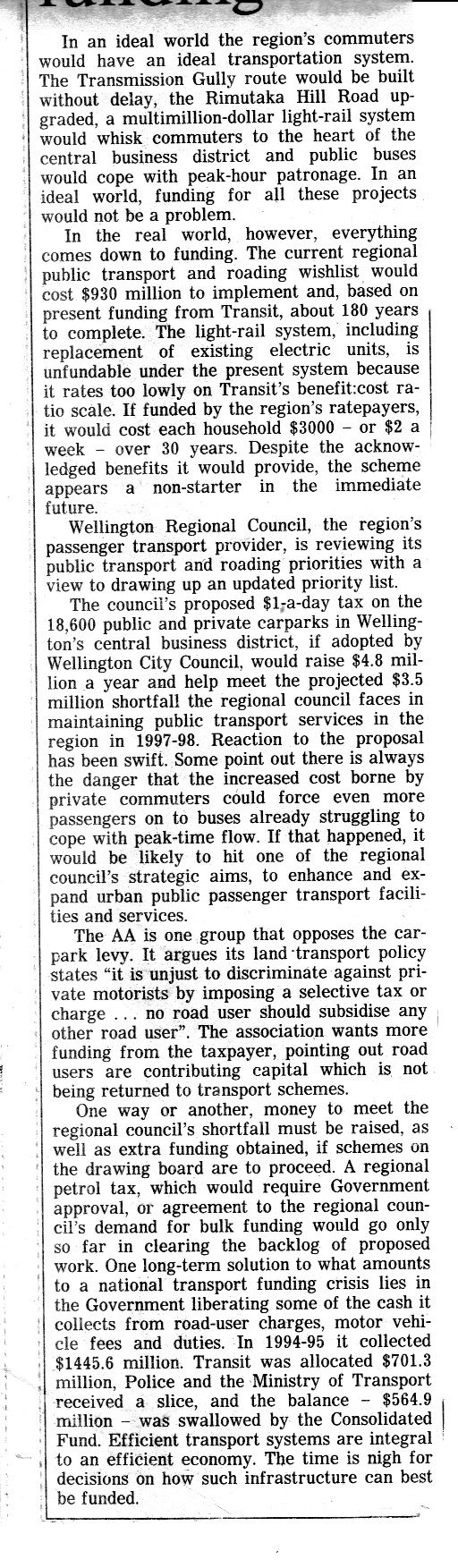
The Evening Post editorial of 22 June 1996 focused on transport funding in Wellington, noting that the $930m wishlist of the Regional Council for roads and public transport would take 180 years to be funded, at the levels available at the time. At the time it included Transmission Gully, a major upgrade to the Rimutaka Hill Road and replacing the old electric multiple units with light rail.  It had proposed a tax on inner city carparks, which did not proceed. The Evening Post proposed that money directed from fuel tax to the Crown account be put into the National Roading Fund.  Ultimately this did happen, but not until after 2008. Subsequently Transmission Gully was funded, along with some upgrades to the Rimutaka Hill Road, but it was decided that light rail was not a viable replacement for the English Electric EMUs in Wellington, and Korean-built "Matangi" units. 

Evening Post 06 September 1996

The Wellington Regional Council transport committee discussed in 1996 the idea of putting a toll on SH1 Ngauranga Gorge to raise money to fund its proposed transport programme. Noting that the only elements of transport in Wellington it has authority to fund are public transport as it is not a road controlling authority.  The proposal would have charged $1 for traffic entering Wellington via the Ngauranga Interchange.  It received widespread opposition and no support from Government, and did not proceed.

Evening Post 22 June 1997


Trucking lobby group, the Road Transport Association (RTA) was highly critical of transport policies in Wellington in 1997, including the specific policy of not increasing the capacity of highways entering Wellington from the north.  Former Minister of Works and Chief Executive of the RTA, Tony Friedlander, was critical of the ruling out of extra capacity between Ngauranga and Petone (which at the time was planned to be a third southbound lane from Horokiwi to Ngauranga using the space of the current cycleway). This had been opposed by the Regional Council.  

The article also notes that trolley buses were to be phased out in five years (which did not occur for another 15 years), and the Wellington Regional Council wanted to tax carparks in Wellington, Hutt and Upper Hutt and Porirua cities.


The above article discussed proposals to four-lane Johnsonville Road from Ngauranga Gorge to the Moorefield Road roundabout.  The land was designated to enable widening, and was proposed to relieve congestion from through traffic adjacent to the retail precinct.  The proposal generated strong opinions in favour and against, but other options were also mentioned, including converting Johnsonville Road to a mall and building a new motorway interchange at Helston Road (to remove through traffic), both ruled out due to cost.  

Evening Post 30 April 1999

The Evening Post in 1999 reported on the draft Land Transport Strategy of the Wellington Regional Council, which was essentially its wishlist of road and public transport projects for the region. Statistics NZ reported that car commuting was falling across the region, with public transport patronage growing.  Proposed projects for roads were:
  • Kapiti Western Link Road (not built, replaced by Kapiti Expressway)
  • Mackays Crossing overbridge (built in the early 2000s)
  • Transmission Gully (completed in 2022)
  • Pauatahanui Bridge upgrade (completed in late 1990s)
  • SH1 improvements Paremata-Pukerua Bay (completed in early 2000s)
  • Rimutaka Hill Road upgrades (some completed in 2010s)
  • Kaitoke realignment (completed in 2000s)
  • SH58/SH2 interchange (completed in 2016)
  • Petone Esplanade upgrade (not undertaken)
  • SH2 Petone-Ngauranga bus lane (not undertaken)
  • Karori bus lane (completed in late 1990s)
  • Inner City Bypass and Adelaide Road upgrade (Stage 2 bypass completed 2007, Adelaide Road upgrade did not proceed)
Public transport projects proposed were:
  • Electrification to Waikanae (completed 2011)
  • Raumati station (never built)
  • Upgrades to Petone, Upper Hutt and Paraparaumu stations
  • Porirua to Hutt bus service (trialled in 1990s but cancelled due to lack of patronage)
  • Bus priority signals and lanes in central Wellington (lanes built)
  • New bus-rail interchange at Wellington station (built in 2000s)
  • Pedestrian covers in central Wellington streets (some built in 2000s)
The Regional Council also proposed light rail from Plimmerton to Whitby (which has not proceeded), between Melling and Waterloo stations (which has not proceeded) and to investigate light rail from Wellington station to the BNZ centre (southern end of Lambton Quay) (the latter is proposed as part of Let's Get Wellington Moving, but extended to Island Bay). 

Evening Post 30 June 1998 and 26 April 1999

These two articles reflect actual funding provided in 1998 and the Wellington Regional Council's proposed Land Transport Strategy in 1999. 

The 1998 article noted that the 1998-1999 National Roading Programme reduced funding for Wellington by 25% from the previous year, although total funding nationally increased by 6.2%.  The reason being that fewer construction work was funded for the 1998-1999 year, because of most of the completion of the Newlands Interchange.  Future construction projects were in the investigation and design stage, specifically the Dowse Drive/Korokoro upgrade on SH2, Kapiti Western Link Road, Karori bus lane and the Daly St extension to Queens Drive, Hutt City.  It was expected those projects would start the following year, but the first two did not.  Funding was provided for completion of the Newlands Interchange. Thorndon motorway viaduct earthquake strengthening, Kapiti Rd SH1 intersection upgrade.

 The article on the right saw the WRC propose to be undertaken between 1999 and 2004:
  • Bus lane on SH2 from Horokiwi to Ngauranga (did not proceed in favour of upgrading cycle lane)
  • Fourth lane on the Urban Motorway from Ngauranga to Aotea Quay with movable median barrier (did not proceed due to technical difficulties)
  • Korokoro-Dowse Drive upgrade/interchange (completed late 2000s)
  • Upgrade to Rimutaka Hill Road (Wellington side largely completed)
  • Stage 2 Inner City Bypass (opened 2007)
It also proposed projects to be undertaken beyond 2004:
  • Transmission Gully (opened 2022) said to cost $245m
  • Kapiti Western Link Road (superseded by Kapiti Expressway) estimated at $24m
  • Hutt to Porirua link road (not built and not pursued) estimated at $62m
  • Upgrading Petone Esplanade (not built)
  • Melling and Kennedy Good Interchanges (Melling funding approved in 2022) estimated at $33m

08 November 2023

Road reforms 1997 and environmental costs of roads


The editorial of The Dominion 15 October 1997 reports that full user pays is on its way, following the report of the Roading Advisory Group (RAG). The RAG conclusions were that the system needed more than minor reforms, nor should it simply have more money spent on it, but also it did not support privatising the roads.  It recommended retaining open access to roads but with user pays. It included ending ratepayer funding for roads, but retaining ratepayer funding of footpaths and cycleways. The editorial mentioned the use of technology to enable road pricing, but also called for an end to direction of some fuel taxes to the Crown account.

Following this report, the Bolger/Shipley Government advanced road reform proposals titled "Better Transport Better Roads", which was to commercialise road management and empower commercial road managers to implement road pricing.  However, these were cancelled by the Clark Government after the 1999 election. There reforms have not been revisited by subsequent governments to date.

 The subsequent two newspaper reports reflect work undertaken by the Ministry of Transport on the environmental impacts of roads. It was one of a series of papers from the Land Transport Pricing Study on environmental externalities. The report estimated costs were between $1b and $4b, with the best estimate being $1.38b per annum.. The main issue being how to separate externalities from costs born privately.  Noise was estimated to cost between $230m and $2.65b, with best estimates being $290m. Water impacts was estimated to cost between $35m and $170m, with best estimates being $100m. Greenhouse gases estimated to cost between $25m and $580m with best estimates being $290m.  The conclusion was that the report helped to indicate what policy responses might be appropriate to externalities. Since that report, two further reports have been prepared which include assessment of the environmental costs of transport, namely Surface Transport Costs and Charges (2002) and Domestic Transport Costs and Charges (2023).

The Independent 29/03/96


Evening Post 30/03/96

26 October 2023

Karori bus lane and Karori Tunnel centenary and possible duplication

Wellington's suburb of Karori has two routes out towards the city, one via Kelburn and down Aro Valley, and another through the Karori Tunnel opened in 1900. The population of Karori at the time was 1,100, today it is around 17,000 people.  A tram line was extended through the tunnel in 1907, but replaced with trolley buses in 1954. There have been various proposals to build a second Karori Tunnel to the south or north of the current tunnel, removing the Glenmore Street hairpin curve, or to connect to Aro Street, but none proceeded far.


The first article is from 1996 when the idea of a bus lane approaching the Karori Tunnel was first floated, and in 1997 Wellington City Council formally proposes the Chaytor Street bus lane approaching from the west.  The feasibility study indicated congestion added 20 minutes to the bus trip from Karori Park to Karori Tunnel in the AM peak.  The cost of the project was estimated at $450,000 with a BCR of 22:1.  The lane proposed was along parts of Karori Road (those sections would not proceed).  The lane was subsequently built, but is now proposed to be removed to make way for an uphill cycling lane.

The last article commemorates the centenary of the Karori Tunnel. Notably it indicates that a second Karori Tunnel is "scheduled" to be built within the next decade (i.e. by 2010) to run parallel to the existing tunnel, and could probably be funded by tolls. It was then estimated to cost $30-40m.  It was noted it was a major bottleneck but traffic lights would not be installed (traffic lights have subsequently been installed to manage bus traffic through the narrow tunnel).

In 2023 there is no second Karori Tunnel being pursued by Wellington City Council.