Search This Blog

Showing posts with label Transfund New Zealand. Show all posts

01 October 2024

1997/98 National Roading Programme : Transfund News June/July 1997 No.5 and In Transit July 1997 No.82


This post contains both the Transfund and Transit NZ newsletters focused on the 1997/1998 National Roading Programme, the second National Roading Programme released by Transfund.  The key point was that the funding threshold for capital works had been lowered from a BCR of 4.5/1 to 4/1 (it had been 5/1 for some years before then). This saw $829.2m (exc.GST) being spent in that year.  This saw a 20% increase in road construction. Main construction projects funded included:

  • Widening Auckland's Northern Motorway northbound from Onewa Rd to Esmonde Rd
  • Albany-Puhoi realignment (Albany-Silverdale-Orewa section)
  • Realignment of SH26 Platts Rd, Waikato District
  • Realignment of SH5 Stockpile curves, Rotorua District
  • Realignment of SH33 Maungarangi S bends, Western BOP District
  • SH1 deviation Taihape
  • Ngaere Overbridge realignment SH3, Stratford District
  • Plimmerton-Pukerua Bay realignment and four laning, SH1 Wellington
  • Realignment Sloans-Tumai, SH1, Otago
  • Stoke Bypass construction SH6
  • Khyber Pass, Symonds St, Newton St intersection upgrade, Auckland City
  • Mt Eden/Balmoral intersection upgrade, Auckland City
  • ALPURT-Orewa Link Road, Rodney District
  • Stage 2 Glenorchy Rd seal extension ,Queenstown-Lakes District
  • Southern Catlins Scenic Route seal extension, Clutha District
Also of note were modest increases in maintenance funding for local roads and state highways, continuation of similar funding for public transport subsidies, and funding for investigation and design works on several major projects notably:
  • Kopu Bridge replacement SH25
  • East Tamaki Corridor Arterial, Manukau City (later built as Te Irirangi Drive)
  • R1 Arterial Hamilton City (later built as Wairere Drive)
  • Kapiti Sandhills Arterial (later cancelled in favour of the Kapiti Expressway on a similar alignment)
It was noted that passenger transport funding was up 25% in Gisborne/Hawke's Bay, 14% in Manawatu/Wanganui/Taranaki and 9.6% in Otago/Southland. 

A separate leaflet on the new structure for Transfund New Zealand was also published (see below)

The In-Transit newsletter focused understandably on the state highway projects. Besides the projects listed above, it also noted funding to improve the Taupo northern access, the Vinegar Hill realignment at SH1/SH54 intersection in Rangitikei District and the widening of seven one-lane bridges on SH6 in Queenstown/Lakes District, as one bridge on SH94.  

Other articles in the In Transit newsletter noted:
  • Development of modelling of traffic flows;
  • Continuing construction of the SH16 Rosebank-Patiki Interchange on Auckland's North-Western Motorway (providing east bound off and on ramps to pair with the westbound ones that had long existed). 


01 March 2024

2000: Clark Government seeks to improve funding for public transport

The 1999 General Election saw Labour win sufficient seats to form a coalition government with the Alliance Party, supported by the Green Party for confidence and supply.  The first Transport Minister under the Clark Government was Mark Gosche.  This article from the NZ Herald on 25 March 2000 reports on reforms he was proposing to change the mix of funding from Transfund New Zealand between roads and public transport. Key points from the article are:

  • Officials asked to review funding rules, this included lifting limits that had been placed on capital and operational spending for passenger transport, and reviewing cost/benefit criteria (the cap was removed).
  • The Northern Busway was expected to obtain funding following changes (not mentioned was a key issue as to what elements of the project were funded by Transfund vs. the three local government agencies relevant to the project).  (The Northern Busway was funded over the coming year.)
  • Negotiations between ARC and Tranz Rail (then privately owned for access to the track in Auckland for expansion of passenger rail services.  (ultimately this would result in the Clark Government buying the Auckland rail network from Tranz Rail for $81m, which was later superseded by nationalisation of the entire rail business).
The outcome of this work was ultimately the Land Transport Management Act, which enabled funding for public transport to be significantly expanded, but also the subsequent merging of Transfund with the Land Transport Safety Authority, and ultimately Transit New Zealand into the NZ Transport Agency.  


19 February 2024

Transfund News - November 1996 - No.3 - Working with local authorities and Alternatives to Roading

 The third edition of Transfund News in 1996 had no major focus, but included articles as follows:

  • Additional funding for territorial authorities to meet the costs of former State Highways that would be redesignated as local roads by Transit New Zealand under the latter's state highway review. The purpose being so that territorial authorities are able to more gradually absorb the local share of costs of roads that are no longer state highways, through other funding sources notably rates increases.
  • Development of Partnership Agreements between Transfund and road controlling authorities and regional councils, to formalise the funding arrangements between them.
  • Competition for construction contracts has been strong, with an average of 4.1 responses for each contract put out for tender by Transit NZ and territorial authorities for road physical works. It was noted that the Competitive Pricing Procedures in 1995 had resulted in a 10-15% reduction in state highway maintenance and construction costs.  Competitive tendering would continue to be rolled out so that by 1998 all minor and ancillary work would be put out to tender.
  • Local Authority Trading Enterprises (LATEs) won one in six local road physical works contracts in the first six months of 1996.  LATEs (now known as commercial Council Controlled Organisations) were the former local authority works departments that were required to be restructured into trading enterprises for local authorities to be able to receive central government funding for road works (this was intended to ensure a level-playing field between council and private contractors).  At the time, Manukau City, Waitomo District, New Plymouth District, Hastings District, Central Hawke's Bay District, Dunedin City and Clutha Districts had LATEs that won such contracts. 
  • Transfund released a discussion document called "Financial Assistance for Alternatives to Roading". It was split into public transport and freight ATRs. The purpose was to recognise that in the absence of road pricing, the land transport system would not be efficient if it only funded roads, if there was infrastructure or services that could be funded to make up the difference between user contribution and the net benefit of the project.  Two key constraints for ATR funding were significant. One was that funding was only available for projects that met the same benefit/cost ratio threshold as road projects that were being funded (in 1996 that was 4.5/1), another was that benefits were primarily benefits to road users as they were the ones paying for the project.
  • Concern about unsafe objects located around road networks, which Transfund can only provide guidelines and recommendations about.
Transfund News November 1996 No. 3 p1
Transfund News November 1996 No. 3 p2

Transfund News November 1996 No. 3 pg3

Transfund News November 1996 No. 3 pg4


01 February 2024

Transfund News - September 1996 - No. 2 - focus on new funding procedures

The second edition of Transfund News followed its first National Roading Programme and contained the following articles:

  • Release of Transfund's first Programme and Funding Manual listing all output classes, work categories and policy changes from when Transit NZ was the funding agency.  Key elements included incorporating safety fully into the capital works outputs, and for road maintenance to be  single output class across state highways and local roads. 
  • Launch of Transfund. Chairman Michael Gross noted that it "removed any potential conflict of interest" in funding.  It also included a dedicated roading fund (as it meant RUC and a portion of fuel excise duty would be hypothecated, and not reliant on the usual annual Budget process) for the first time, providing security of funding for capital and maintenance funding. Also noted was the ability to fund "efficient alternatives to roading". 
  • Removal of First Year Rate of Return as a funding criteria element, as increases in funding no longer rendered it necessary to ration project funding.  This was a measurement of the proportion of benefits a project would generate in its first year, compared to later years, as an additional element to determine whether a project which met the benefit/cost ration threshold had a higher priority for funding over others.
  • Contracts will be created between Transfund and Transit NZ, territorial authorities and regional councils for funding granted to them.  This reflects Transfund's role as purchase of services on behalf of road users and the desire to ensure good performance. 
  • Strong response to discussion paper on funding "efficient alternatives to roading", with final evaluation procedures to be decided at the end of the year.
  • Funding proposal procedures to be tightened.  This followed a report that indicated 34% of projects reviewed had significant shortcomings in their Benefit/Cost Ratio calculations.. Road controlling authorities are to be required to undertake peer reviews of their calculations. 
  • New software enables quicker calculation of benefits for projects that reduce accident costs

Transfund News September 1996 No.2 pg1
Transfund News September 1996 No.2 pg2

Transfund News September 1996 No.2 pg3


Transfund News September 1996 No.2 pg4


19 January 2024

1997: Interview with Transfund NZ Chair in Opus newsletter

In June/July 1997, Opus Consultants (the new name for Works Consultancy, the former Minister of Works and Development's consultancy arm after it had been privatised) produced its Momentum newsletter, which included an interview with then Transfund NZ Chairman Michael Gross.  The key points were:
  • Establishment of Transfund was central to a wider range of reforms of the roading system.
  • NZ's road network was seen as a model of change internationally by the World Bank
  • Setting up of Transfund is expected to make the system more efficient by assisting development and co-ordination of national and regional strategies.  It operates like a private company, with the security of revenue to develop long-term strategic solutions.
  • Gross said despite recent increases in funding (enabling the BCR for funding to drop to 4), the system is still underfunded.
  • NZ has a low capital/high maintenance road system meaning roads have relatively short lives, and Transfund is looking how to optimise this.
  • Alternatives to roading funding is to find ways to overcome the distortions of existing means of charging for road use, which doesn't address externalities such as congestion, environmental degradation and social dislocation.  Options it could fund include barging logs instead of massive road upgrades or new passenger transport systems to avoid building new road capacity, but is unlikely to provide funds for large projects like light rail.
  • The forthcoming Road Pricing Study is expected to document options for road pricing and the need for decisions.  Options include congestion charging, suggesting use of smart card technology, and replacement of rats with some form of access charge for properties to access the road corridor, with registration covering the right to use the network.
  • Gross thought a purely commercial model would be difficult to apply and need effort to ensure lightly trafficked rural roads were adequately funded, as urban areas generate far more income than the costs of maintaining those roads.
Momentum June/July 1997 - interview with Michael Gross


30 November 2023

1996: National Roading Programme: Auckland/Northland NRP news

 The Auckland/Northland newsletter for the 1996 National Roading Programme of Transfund NZ.

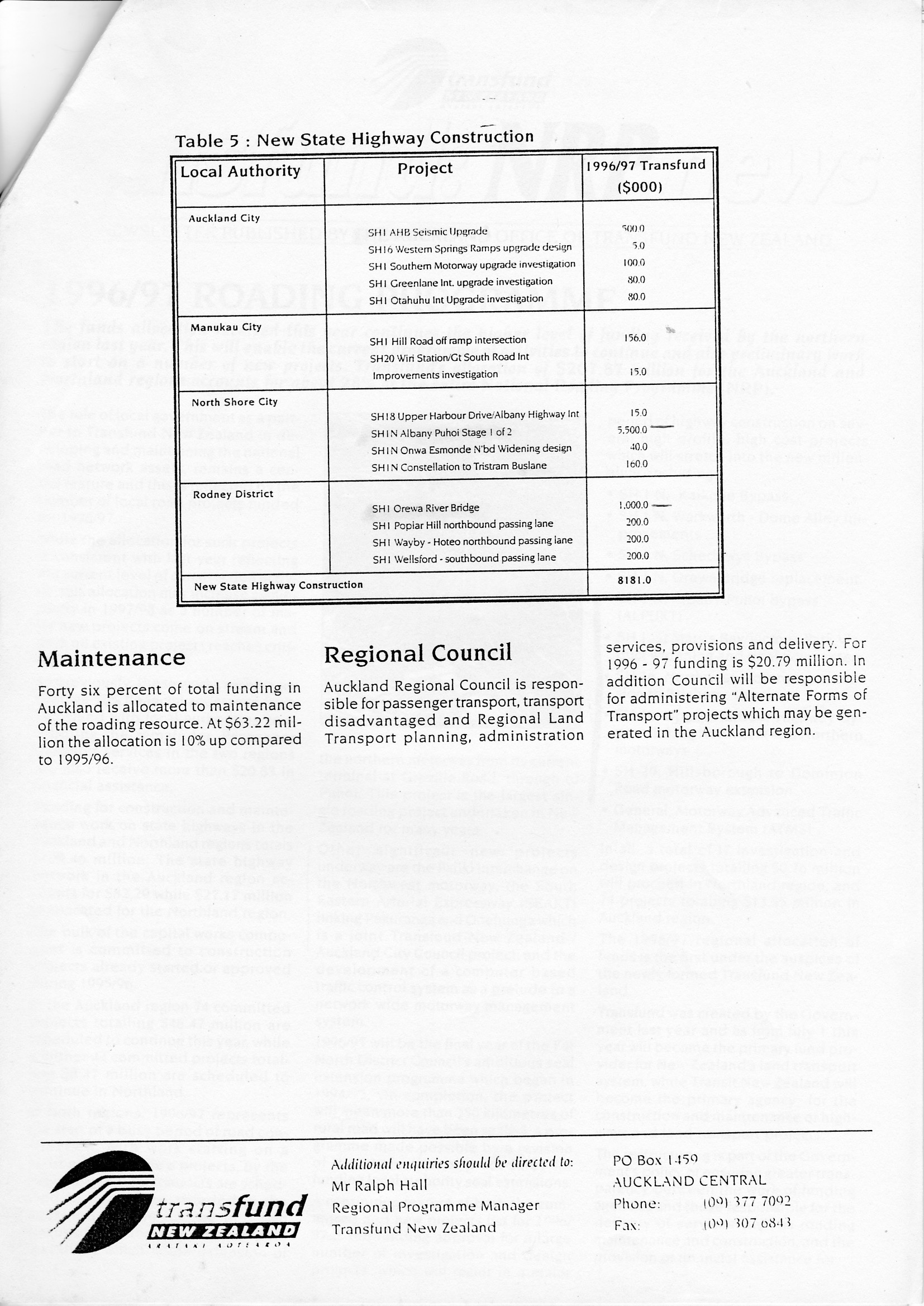
It was noted that 46% of spending in Auckland was road maintenance.  The newsletter has a comprehensive list of all state highway and local road projects funded, including investigation and design in Auckland and Northland. Notable in this NRP was approval of funding for the extension of the Northern Motorway from Albany to Silverdale, which continued to Orewa until funding to proceed was suspended in the early 2000s until tolling was authorised for the Orewa to Puhoi section. Investigation and design also began for a series of other major motorway projects in Auckland, including extensions of SH16 and the Upper Harbour Motorway SH18.

Major committed projects included:

  • SH16 Northwestern Motorway Rosebank and Patiki Rd Interchange construction
  • SH20 Southwestern Motorway extension Quarry Rd (Mangere Bridge) to Massey Rd (Papatoetoe), connecting the Mangere Bridge to the Pupatoetoe Bypass, and towards the Airport to George Bolt Memorial Drive
  • Auckland City Southeastern Arterial (Church Street-Mt Wellington-Pakuranga Motorway).

New construction projects included:

  • SH1 Northern Motorway extension Albany to Silverdale
  • SH1 Auckland Harbour Bridge seismic upgrade
  • SH1 Orewa Bridge replacement (pre Silverdale-Puhoi extension of Northern Motorway)
  • SH1 Puhoi-Wellsford passing lanes
  • 16km of seal extensions in Rodney District
  • Wairau Road intersection upgrades in North Shore
  • Thirteen seal extension projects in Far North District
  • Eight seal extension projects in Whangarei District

New investigation and design work was funded for future projects:

  • SH1 Warkworth-Dome Alley improvements
  • SH1 Schedewys Bypass
  • SH1 St Marys Bay/Victoria Park Viaduct widening/tidal flow (this did NOT proceed and was replaced by the Victoria Park Tunnel)
  • SH16 Northwestern Motorway Brighams Creek extension
  • SH18 Upper Harbour Motorway
  • SH20 Southwestern Motorway extension Hillsborough to Dominion Road
  • SH1 Southern Motorway Greenland Interchange upgrade
  • SH1 Southern Motorway Otahuhu Interchange upgrade
  • Auckland ATMS
  • Orewa Link Road to connect to Silverdale-Puhoi extension of Northern Motorway


Transfund NRP news Auckland Office pg1

Transfund NRP news Auckland Office pg2


Transfund NRP news Auckland Office pg3
Transfund NRP news Auckland Office pg4


Transfund NRP news Auckland Office pg5

Transfund NRP news Auckland Office pg6

Transfund NRP news Auckland Office pg7

Transfund NRP news Auckland Office pg8

29 November 2023

1996 National Roading Programme: Waikato/BOP NRP news

The Waikato/Bay of Plenty regional spending for the 1996 National Roading Programme had the following main statistics:

  • $99.47m for Waikato. State Highway maintenance and construction spending was the main output class, with 50% of spending. 
  • $44.44m for the Bay of Plenty. State Highway maintenance and construction spending was the main output class, with 51% of spending.
Main increases for state highway spending were for additional reseals, additional pavement rehabilitation and additional road markings.

Safety projects of note were:

  • Hamilton City arterial street lighting upgrade
  • Rotokauri Street safety improvements, Hamilton City
  • SH2 Sargents Corner realignment 
  • SH27 Maukoro Landing Road intersection upgrade
  • SH5 Tarukenga Curves Stage 2 realignment
  • SH5 Tumunui South realignment
  • 32.3km of seal extension throughout both regions
No new state highway construction projects were approved because of the high value of committed works, and all but two local road construction projects were seal extension projects. The seal extension projects were in Otorohonga District, Waitomo District, Opotiki District, Western Bay of Plenty District and Whakatane District.

Committed major projects included:
  • SH1 Pokeno Bypass (extension of Waikato Expressway)
  • SH1 Mangatawhiri Bridge realignment (part of Waikato Expressway)
  • Hamilton City Pukete Arterial Stage 1
  • SH2 Church-Timber Mill
  • SH25 Kuaotunu Hill seal extension
  • SH25 Coromandel-Whangapoua seal extension
  • SH5 Earthquake Flats realignment

Transfund NRP news Hamilton Office 1996 p1


Transfund NRP news Hamilton Office 1996 p2


Transfund NRP news Hamilton Office 1996 p3

Transfund NRP news Hamilton Office 1996 p4


Transfund NRP news Hamilton Office 1996 p5


Transfund NRP news Hamilton Office 1996 p6

28 November 2023

1996 National Roading Programme: Hawke's Bay/Gisborne NRP news

The 1996 National Roading Programme Napier regional office newsletter covers funding for the Hawke's Bay and Gisborne regions.  The primary focus for new work was local road seal extensions.

New construction projects funded included:
  • Hawke's Bay Expressway (then called Motorway) extension enabling works Hastings to Pakowhai
  • SH5 Beatties to Marshalls realignment
  • East Cape Road seal extension 10km, Gisborne District
  • Anaura Road seal extension 2.2km, Gisborne District
  • Mangatu Road seal extension 4km, Gisborne District
  • Mill/Lawn roundabout construction, Hastings District
  • Napier-Taihape Road seal extensions, Hastings District
  • Tangoio Road seal extension, Hastings District
  • Kahuranaki Possum Bridge replacement, Hastings District
  • Stardust (Mill) Bridge replacement, Napier Road, Hastings District
  • Mohaka Township Road seal extension, Wairoa District
  • Tiniroto Road seal completion (5km), Gisborne District
Also funded were major design projects including:
  • Hawke's Bay Expressway Omahu-York Road (Hastings to Flaxmere)
  • White Pine Bush S. Realignment, SH2
  • King's Woolshed Realignment SH2
  • Glengarry Hill Realignment SH5


27 November 2023

1996 National Roading Programme: Manawatu/Taranaki NRP news

The 1996 National Roading Programme Wanganui regional office newsletter covers funding for the Manawatu and Taranaki regions. Key statistics were:

  • $53.3m for the Manawatu region and $18.6m for the Taranaki region.
  • Largest output class for the Manawatu was local road maintenance and construction at 40.5% of spending
  • Largest output class for the Taranaki region was state highway maintenance and construction at 41.1% of spending
Major committed projects included:
  • SH4 Laurence's Dropout
  • SH3 Maxwell to Bushy Park upgrade
  • SH57 Laws Hill realignment
  • FItzherbert Avenue 4-laning in Palmerston North City
New construction projects funded included:
  • 7.6km seal extension on SH43 Moki Tunnel
  • SH3 realignment Mimi Curves
  • SH1 Vinegar Hill realignment ($5.1m)
  • SH43 Tahora Flats seal extension of 2.3km
  • SH1 realignment south of Waiouru railway crossing
  • SH2 Bradleys realignment south of Dannevirke
  • SH3 Grants Hill corner realignment
  • SH4 Waihapa curves easing


23 November 2023

1996 National Roading Programme: Wellington NRP news

 The Wellington regional newsletter of the 1996 NRP has the following key statistics:

  • $62m for the Wellington region
  • $26.9m for the Nelson/Marlborough/Tasman districts
  • For the Wellington region, state highway maintenance and construction is the largest output class comprising 34.9% of spending. Passenger transport was 25.4% of spending as the second largest output class.
  • For Nelson/Marlborough/Tasman, state highway maintenance and construction was also the largest output class at 55.2% of spending
Unlike Christchurch, the Wellington newsletter contained little detail, noting the following committed projects:
  • SH58 Judgeford realignment
  • SH1 Newlands Interchange
  • SH2 Gibbons Street seagull roundabout Upper Hutt
New projects funded included:
  • SH6 Stoke Bypass, Nelson (the largest road project in the region)
  • SH1 Basin Reserve traffic signals
  • SH1 Paraparaumu widening
  • SH60 reconstruction between Maisey and Bronte
  • SH1 Thorndon motorway viaduct further strengthening 
  • SH6 Spooners Hill passing lane
  • Mungavin Bridge duplication, Porirua