Search This Blog

Showing posts with label road funding. Show all posts

01 March 2024

2000: Clark Government seeks to improve funding for public transport

The 1999 General Election saw Labour win sufficient seats to form a coalition government with the Alliance Party, supported by the Green Party for confidence and supply.  The first Transport Minister under the Clark Government was Mark Gosche.  This article from the NZ Herald on 25 March 2000 reports on reforms he was proposing to change the mix of funding from Transfund New Zealand between roads and public transport. Key points from the article are:

  • Officials asked to review funding rules, this included lifting limits that had been placed on capital and operational spending for passenger transport, and reviewing cost/benefit criteria (the cap was removed).
  • The Northern Busway was expected to obtain funding following changes (not mentioned was a key issue as to what elements of the project were funded by Transfund vs. the three local government agencies relevant to the project).  (The Northern Busway was funded over the coming year.)
  • Negotiations between ARC and Tranz Rail (then privately owned for access to the track in Auckland for expansion of passenger rail services.  (ultimately this would result in the Clark Government buying the Auckland rail network from Tranz Rail for $81m, which was later superseded by nationalisation of the entire rail business).
The outcome of this work was ultimately the Land Transport Management Act, which enabled funding for public transport to be significantly expanded, but also the subsequent merging of Transfund with the Land Transport Safety Authority, and ultimately Transit New Zealand into the NZ Transport Agency.  


19 February 2024

Transfund News - November 1996 - No.3 - Working with local authorities and Alternatives to Roading

 The third edition of Transfund News in 1996 had no major focus, but included articles as follows:

  • Additional funding for territorial authorities to meet the costs of former State Highways that would be redesignated as local roads by Transit New Zealand under the latter's state highway review. The purpose being so that territorial authorities are able to more gradually absorb the local share of costs of roads that are no longer state highways, through other funding sources notably rates increases.
  • Development of Partnership Agreements between Transfund and road controlling authorities and regional councils, to formalise the funding arrangements between them.
  • Competition for construction contracts has been strong, with an average of 4.1 responses for each contract put out for tender by Transit NZ and territorial authorities for road physical works. It was noted that the Competitive Pricing Procedures in 1995 had resulted in a 10-15% reduction in state highway maintenance and construction costs.  Competitive tendering would continue to be rolled out so that by 1998 all minor and ancillary work would be put out to tender.
  • Local Authority Trading Enterprises (LATEs) won one in six local road physical works contracts in the first six months of 1996.  LATEs (now known as commercial Council Controlled Organisations) were the former local authority works departments that were required to be restructured into trading enterprises for local authorities to be able to receive central government funding for road works (this was intended to ensure a level-playing field between council and private contractors).  At the time, Manukau City, Waitomo District, New Plymouth District, Hastings District, Central Hawke's Bay District, Dunedin City and Clutha Districts had LATEs that won such contracts. 
  • Transfund released a discussion document called "Financial Assistance for Alternatives to Roading". It was split into public transport and freight ATRs. The purpose was to recognise that in the absence of road pricing, the land transport system would not be efficient if it only funded roads, if there was infrastructure or services that could be funded to make up the difference between user contribution and the net benefit of the project.  Two key constraints for ATR funding were significant. One was that funding was only available for projects that met the same benefit/cost ratio threshold as road projects that were being funded (in 1996 that was 4.5/1), another was that benefits were primarily benefits to road users as they were the ones paying for the project.
  • Concern about unsafe objects located around road networks, which Transfund can only provide guidelines and recommendations about.
Transfund News November 1996 No. 3 p1
Transfund News November 1996 No. 3 p2

Transfund News November 1996 No. 3 pg3

Transfund News November 1996 No. 3 pg4


01 February 2024

Transfund News - September 1996 - No. 2 - focus on new funding procedures

The second edition of Transfund News followed its first National Roading Programme and contained the following articles:

  • Release of Transfund's first Programme and Funding Manual listing all output classes, work categories and policy changes from when Transit NZ was the funding agency.  Key elements included incorporating safety fully into the capital works outputs, and for road maintenance to be  single output class across state highways and local roads. 
  • Launch of Transfund. Chairman Michael Gross noted that it "removed any potential conflict of interest" in funding.  It also included a dedicated roading fund (as it meant RUC and a portion of fuel excise duty would be hypothecated, and not reliant on the usual annual Budget process) for the first time, providing security of funding for capital and maintenance funding. Also noted was the ability to fund "efficient alternatives to roading". 
  • Removal of First Year Rate of Return as a funding criteria element, as increases in funding no longer rendered it necessary to ration project funding.  This was a measurement of the proportion of benefits a project would generate in its first year, compared to later years, as an additional element to determine whether a project which met the benefit/cost ration threshold had a higher priority for funding over others.
  • Contracts will be created between Transfund and Transit NZ, territorial authorities and regional councils for funding granted to them.  This reflects Transfund's role as purchase of services on behalf of road users and the desire to ensure good performance. 
  • Strong response to discussion paper on funding "efficient alternatives to roading", with final evaluation procedures to be decided at the end of the year.
  • Funding proposal procedures to be tightened.  This followed a report that indicated 34% of projects reviewed had significant shortcomings in their Benefit/Cost Ratio calculations.. Road controlling authorities are to be required to undertake peer reviews of their calculations. 
  • New software enables quicker calculation of benefits for projects that reduce accident costs

Transfund News September 1996 No.2 pg1
Transfund News September 1996 No.2 pg2

Transfund News September 1996 No.2 pg3


Transfund News September 1996 No.2 pg4


16 November 2023

Transfund News No. 1 July 1996 - National Roading Programme

This the very first edition of Transfund news following the launching of the Crown agency as the dedicated land transport funding agency, separated from Transit New Zealand (which remained as the state highway manager).  The edition was understandably focused on the 1996/1997 National Roading Programme, Transfund's first. It had previously been called the National Land Transport Programme reflecting funding for both roads and public transport, but the new emphasis was to reflect Transfund's role as essentially a purchaser of road maintenance and improvements, and public transport services, on behalf of motorists.

 Key elements were:

  • $743.7m ($1.45b in 2023 prices) in total spending for the year (compared to $675.9m the previous year, a 10% increase).
  • The increase reflected a Budgetary increase of $122.9m over the subsequent three years.
  • The benefit/cost threshold for capital spending was reduced from 5:1 to 4.5:1 for the 1996/97 year and to 4:1 for the 1997/98 year. This reflected Government confidence in Transfund ensuring quality of spending and the general Budget entering surplus (enabling a greater proportion of fuel tax revenue to be directed to the National Roads Fund).
  • The three-year cap on passenger transport funding was removed.
  • Passenger transport funding was increased by $13.5m to replace funding removed due to abolition of regional fuel taxes.
  • Additional spending was otherwise focused on increased maintenance, minor safety projects, new state highway construction projects, bridge reconstruction, continuation of seal extension.
  • Major projects to start included:
    • Albany-Silverdale section of the Albany-Puhoi realignment (SH1 Northern Motorway)
    • Otira Viaduct SH73 Canterbury
    • Stoke Bypass SH6 Nelson
    • Orewa River Bridge Auckland
    • Thorndon motorway viaduct seismic upgrade SH1 Wellington
  • The newsletter contained a table comparing the previous year's spending by output class.


Transfund News July 1996 No.1 Pg1

Transfund News July 1996 No.1 Pg2

Transfund News July 1996 No.1 Pg3


Transfund News July 1996 No.1 Pg4

13 November 2023

Wellington traffic and transport funding woes in the 1990s

This post is a series of articles from 1990 through to 1999 discussing the issues and funding of roads and urban transport more generally in Wellington.


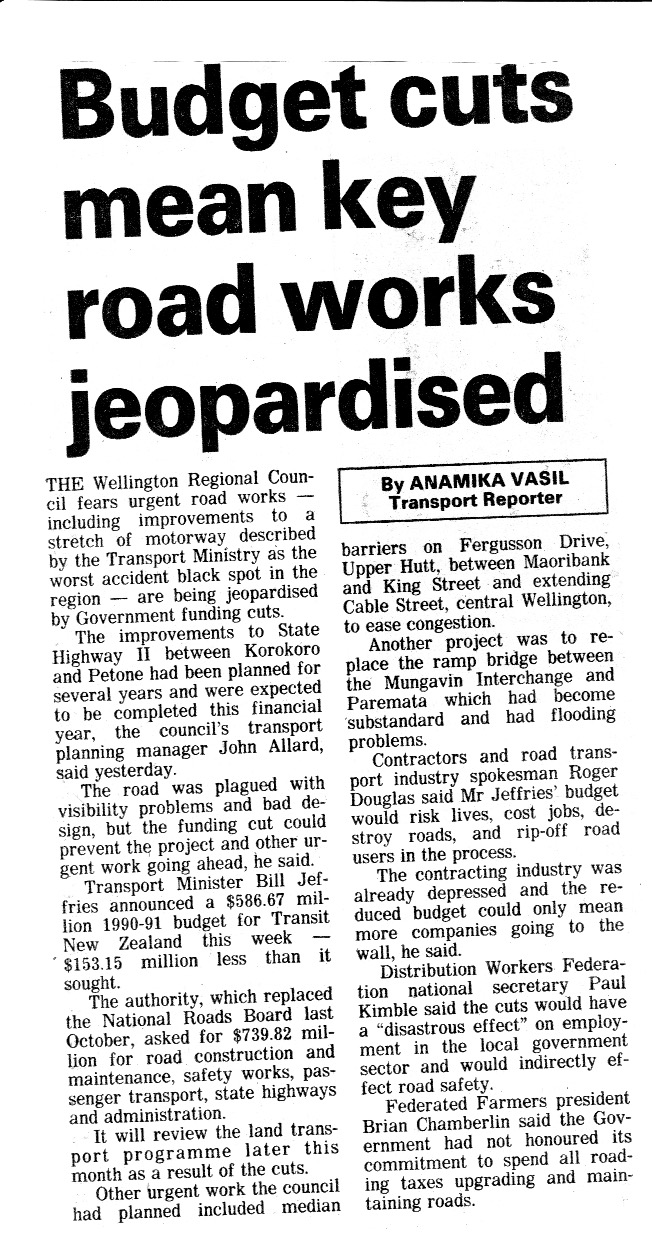
This article from 1990 reflects the cuts in funding in the last budget under the Fourth Labour Government, at the time under Geoffrey Palmer, which provided $153m less funding that Transit New Zealand sought.  Projects threatened (and delayed) were:

  • Korokoro/Petone upgrade to SH2 (which was not undertaken until the late 1990s)
  • Fergusson Drive median barriers Upper Hutt City (which did not proceed)
  • Cable Street extension Wellington (which did proceed to create the one-way system with Wakefield Street)
  • Ramp Bridge replacement Porirua, SH1 (which proceeded in the late 1990s.


This feature by Kate Coughlan in The Dominion describes the major traffic problems in Wellington in the 1990s.  It concludes that there is unlikely to be any significant relief. It summarises some of the issues of driving in the morning peak and follow by a map with traffic figures describing the main choke points. 


This summary is a fair report of the key traffic bottlenecks across the region in 1996.  To review where these now are in 2013:
  • Paremata-Pukerua Bay: The proposed solution at the time was implemented, with a second Paremata Bridge, clearways, traffic lights through to Plimmerton and four-laning through Plimmerton.  This relieved congestion at this location, but Pukerua Bay became the major bottleneck. This was addressed long-term with the Transmission Gully motorway, although the forecast it would be open by 2006 proved to be more than a decade out.
  • SH2:  In 1996 the problems were the intersections at Korokoro and Melling. The best solution mooted was the Cross Valley Link (which has not yet been built), but the proposed solution was grade separation at Korokoro, Dowse Drive and Melling.  Korokoro and Dowse Drive were built in the early 2000s, but Melling although funded is yet to commence construction.  In 2023, Melling remains a major bottleneck, but north of Manor Park, SH2 is particularly slow in the AM peak.
  • Mungavin Avenue: In 1996, the Mungavin Roundabout queued back to Cannons Creek. As reported, the solution was a duplicate Mungavin Bridge, which was built in 1998 and addressed the bottleneck.
  • Newlands lights:  The busiest traffic light controlled intersection on SH1 was a major bottleneck, but as reported, the Newlands Interchange had been funded and would permanently relieve this bottleneck. 
  • Wellington city motorway offramps: Not specific on the ramps, but noted that policy was to discourage car commuting into the CBD, and encourage public transport use by sustaining subsidies for rail and bus services.  This appears largely to have succeeded as traffic to the Wellington CBD in the AM peak has been flat for over 20 years.
  • Karori Road:  The Karori Tunnel and Karori Road were bottlenecks with very slow traffic at the time and this has not changed. The best solution at the time was said to be to widen Karori Road and duplicate the tunnel, but the expected solution was a bus lane.  The outcome was the Chaytor Street bus lane, which is soon to be removed to accommodate an uphill cycle lane under Let's Get Wellington Moving.  Karori Tunnel remains a bottleneck.
  • Mt Victoria Tunnel/Basin Reserve:  The 1996 bottleneck was traffic exiting Mt Victoria Tunnel to the Basin Reserve, and from Adelaide Road. The preferred solution was grade-separation at the Basin Reserve, but planned solution was traffic signals. In 2023, the Basin Reserve is a major bottleneck, as is the tunnel. 
  • Terrace Tunnel to Mt Victoria Tunnel: Congestion between the two tunnels was chronic in the 1990s with the dog-leg route between the tunnels.  The preferred solution was to duplicate the tunnels and connect them with the proposed cut-and-cover motorway extension. However, what was expected was the "Inner City Bypass" of Karo Drive with a one-way system. This was expected to be completed by 2000, but did not finish until 2007.  In 2023, the two tunnels are major bottlenecks, and Vivian Street/Karo Drive are regularly congested at peak times.
  • The Merge (SH2/SH1 Ngauranga): This was described as caused by incompetent driving and the solution was Police presence at the site encouraging better behaviour.  In 2023, the issue remains although northbound in the PM peak, the addition of a fourth lane from Aotea Quay has greatly eased congestion in that direction.
Evening Post 25 June 1996

Meanwhile, the Business Roundtable believed that the time was right to end public transport subsidies, and that the Wellington Regional Council should progressively reduce such subsidies and ensure services paid their own way, and allow more bus services to compete with rail. These proposals were not taken up.


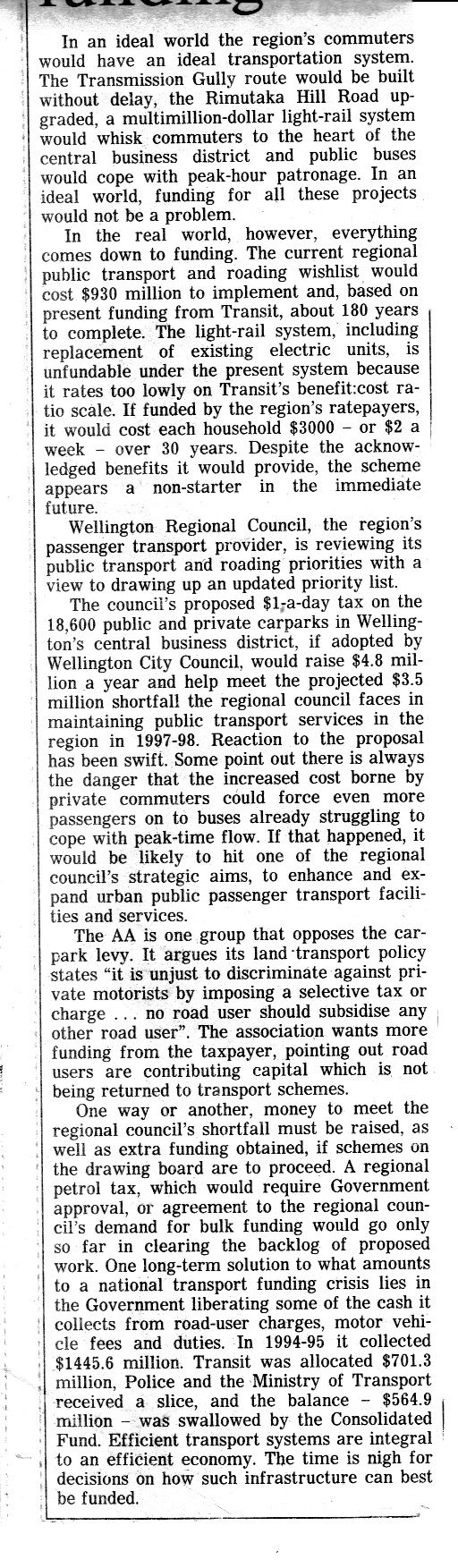
The Evening Post editorial of 22 June 1996 focused on transport funding in Wellington, noting that the $930m wishlist of the Regional Council for roads and public transport would take 180 years to be funded, at the levels available at the time. At the time it included Transmission Gully, a major upgrade to the Rimutaka Hill Road and replacing the old electric multiple units with light rail.  It had proposed a tax on inner city carparks, which did not proceed. The Evening Post proposed that money directed from fuel tax to the Crown account be put into the National Roading Fund.  Ultimately this did happen, but not until after 2008. Subsequently Transmission Gully was funded, along with some upgrades to the Rimutaka Hill Road, but it was decided that light rail was not a viable replacement for the English Electric EMUs in Wellington, and Korean-built "Matangi" units. 

Evening Post 06 September 1996

The Wellington Regional Council transport committee discussed in 1996 the idea of putting a toll on SH1 Ngauranga Gorge to raise money to fund its proposed transport programme. Noting that the only elements of transport in Wellington it has authority to fund are public transport as it is not a road controlling authority.  The proposal would have charged $1 for traffic entering Wellington via the Ngauranga Interchange.  It received widespread opposition and no support from Government, and did not proceed.

Evening Post 22 June 1997


Trucking lobby group, the Road Transport Association (RTA) was highly critical of transport policies in Wellington in 1997, including the specific policy of not increasing the capacity of highways entering Wellington from the north.  Former Minister of Works and Chief Executive of the RTA, Tony Friedlander, was critical of the ruling out of extra capacity between Ngauranga and Petone (which at the time was planned to be a third southbound lane from Horokiwi to Ngauranga using the space of the current cycleway). This had been opposed by the Regional Council.  

The article also notes that trolley buses were to be phased out in five years (which did not occur for another 15 years), and the Wellington Regional Council wanted to tax carparks in Wellington, Hutt and Upper Hutt and Porirua cities.


The above article discussed proposals to four-lane Johnsonville Road from Ngauranga Gorge to the Moorefield Road roundabout.  The land was designated to enable widening, and was proposed to relieve congestion from through traffic adjacent to the retail precinct.  The proposal generated strong opinions in favour and against, but other options were also mentioned, including converting Johnsonville Road to a mall and building a new motorway interchange at Helston Road (to remove through traffic), both ruled out due to cost.  

Evening Post 30 April 1999

The Evening Post in 1999 reported on the draft Land Transport Strategy of the Wellington Regional Council, which was essentially its wishlist of road and public transport projects for the region. Statistics NZ reported that car commuting was falling across the region, with public transport patronage growing.  Proposed projects for roads were:
  • Kapiti Western Link Road (not built, replaced by Kapiti Expressway)
  • Mackays Crossing overbridge (built in the early 2000s)
  • Transmission Gully (completed in 2022)
  • Pauatahanui Bridge upgrade (completed in late 1990s)
  • SH1 improvements Paremata-Pukerua Bay (completed in early 2000s)
  • Rimutaka Hill Road upgrades (some completed in 2010s)
  • Kaitoke realignment (completed in 2000s)
  • SH58/SH2 interchange (completed in 2016)
  • Petone Esplanade upgrade (not undertaken)
  • SH2 Petone-Ngauranga bus lane (not undertaken)
  • Karori bus lane (completed in late 1990s)
  • Inner City Bypass and Adelaide Road upgrade (Stage 2 bypass completed 2007, Adelaide Road upgrade did not proceed)
Public transport projects proposed were:
  • Electrification to Waikanae (completed 2011)
  • Raumati station (never built)
  • Upgrades to Petone, Upper Hutt and Paraparaumu stations
  • Porirua to Hutt bus service (trialled in 1990s but cancelled due to lack of patronage)
  • Bus priority signals and lanes in central Wellington (lanes built)
  • New bus-rail interchange at Wellington station (built in 2000s)
  • Pedestrian covers in central Wellington streets (some built in 2000s)
The Regional Council also proposed light rail from Plimmerton to Whitby (which has not proceeded), between Melling and Waterloo stations (which has not proceeded) and to investigate light rail from Wellington station to the BNZ centre (southern end of Lambton Quay) (the latter is proposed as part of Let's Get Wellington Moving, but extended to Island Bay). 

Evening Post 30 June 1998 and 26 April 1999

These two articles reflect actual funding provided in 1998 and the Wellington Regional Council's proposed Land Transport Strategy in 1999. 

The 1998 article noted that the 1998-1999 National Roading Programme reduced funding for Wellington by 25% from the previous year, although total funding nationally increased by 6.2%.  The reason being that fewer construction work was funded for the 1998-1999 year, because of most of the completion of the Newlands Interchange.  Future construction projects were in the investigation and design stage, specifically the Dowse Drive/Korokoro upgrade on SH2, Kapiti Western Link Road, Karori bus lane and the Daly St extension to Queens Drive, Hutt City.  It was expected those projects would start the following year, but the first two did not.  Funding was provided for completion of the Newlands Interchange. Thorndon motorway viaduct earthquake strengthening, Kapiti Rd SH1 intersection upgrade.

 The article on the right saw the WRC propose to be undertaken between 1999 and 2004:
  • Bus lane on SH2 from Horokiwi to Ngauranga (did not proceed in favour of upgrading cycle lane)
  • Fourth lane on the Urban Motorway from Ngauranga to Aotea Quay with movable median barrier (did not proceed due to technical difficulties)
  • Korokoro-Dowse Drive upgrade/interchange (completed late 2000s)
  • Upgrade to Rimutaka Hill Road (Wellington side largely completed)
  • Stage 2 Inner City Bypass (opened 2007)
It also proposed projects to be undertaken beyond 2004:
  • Transmission Gully (opened 2022) said to cost $245m
  • Kapiti Western Link Road (superseded by Kapiti Expressway) estimated at $24m
  • Hutt to Porirua link road (not built and not pursued) estimated at $62m
  • Upgrading Petone Esplanade (not built)
  • Melling and Kennedy Good Interchanges (Melling funding approved in 2022) estimated at $33m

10 November 2023

In Transit - May 1996 No. 73 - Environmental benefits from sealing SH12 through Waipoua Forest

 The May 1996 edition of In Transit primarily focused on the following:

  • Benefits of completion of the sealing of SH12 in Northland through the Waipoua Kauri Forest.  The benefits including less dust, fewer weeds and less runoff.  Sealing the final 10km of SH12 cost $5.5m and was the final section of state highway in Northland that was unsealed.  The project included "footbridges" to protect Kauri trees adjacent to the road. 
  • A  discussion paper on funding Alternatives to Roading was released. This funding output class would be available from July when Transfund took over land transport funding functions from Transit.  It was explicitly created because the lack of road pricing meant that relative prices between modes did not reflect the benefits of funding activities for non-road modes. Types of projects expected to be funded include those that remove trucks from roads with high-maintenance costs and passenger transport activities that could reduce congestion.
  • Development of the national traffic database. This includes data that estimates the revenue generated from different parts of the network relative to expenditure. Some data points included:
    • State highways are 11% of the network but carry 44% of VKT
    • Unsealed roads are 40% of the network but carry 3% of VKT
In Transit May 1996 No.73 Page 1

In Transit May 1996 No.73 Page 2

In Transit May 1996 No.73 Page 3

In Transit May 1996 No.73 Page 4

03 November 2023

In Transit - April 1996 No. 72 - Trialling salt on the Desert Road - lowest quarterly road toll since 1979

 The April 1996 edition of In Transit included the following articles:

  • Transit NZ trialling use of salt on the Desert Rd (SH1) over winter to keep it open from ice
  • New approval process for National Roading Programme released by Transfund Establishment Board. This approves road maintenance and passenger transport subsidies first, before approving capital spending, advisory, audit and contract management funding.
  • Testing of the SH1 Wellington Thorndon Motorway viaduct earthquake strengthening proves refit significantly improved its resilience against a major earthquake.
  • First quarter road toll for 1996 lowest since 1979, attributed to safety advertising, increased enforcement and safety audit/black spot investigations on the road network.
  • Report published on the engineering challenges of building the Transmission Gully motorway, which were substantial, although no decisions had yet been made on the preferred route.
  • Roadside interviews carried out of motorists about their trip patterns.


31 October 2023

In Transit - February 1996 - Set up of Transfund

The February 1996 issue of In Transit newsletter led with announcement of the Transfund New Zealand Establishment Board to set up Transfund New Zealand later in that year. Transfund would take over the land transport funding function from Transit New Zealand (leaving Transit New Zealand's sole function as the state highway manager).  This functional separation was undertaken in the second term of the Bolger Government, but would be reversed in the third term of the Clark Government in 2008.

Other stories in this newsletter include:

  • Realignment of a flood prone section of SH7 west of Hammer
  • Start of a project to seal 23km of Far North District roads north of the Hokianga, funded 62% by Transit New Zealand. This reflected a revision to project evaluation procedures that increased the value of sealing roads. It was noted that at the time 77% of roads (by distance) in the Far North District were unsealed.
  • A five-fold increase in logging expected in Northland by 2005 following a survey of local timber companies.
  • A survey of Transit's performance sent to local authorities and consultants.
  • Near completion of the Pott's Hill realignment on SH57 north of Levin, at a cost of $2.1m.  This realigned a previously dangerous and winding section of highway.
  • Project audits of 15 projects indicated 13 out of the 15 met or exceeded the funding cutoff of a BCR off 5. 
  • Sponsored roadside toilets.
  • Moves to ensure speed advisory signs (applied to approaching corners) are applied more consistently, so drivers can respond to them more appropriately.


23 October 2023

Wellington traffic congestion in 1988 and proposed funding reforms

In 1988 the Dominion ran a major story about traffic congestion in Wellington which reviewed what might be done about it.  It followed on from proposals from Minister Bill Jefferies to combine road and public transport funding and also reflected the view at the time that the future for Wellington transport was not to seek to respond entirely to the growth in car traffic. It noted at the time that 42% of commuters to central Wellington travelled by public transport.  At the time buses in Wellington were provided by Wellington City Transport, which was a WCC owned monopoly, and in the Hutt/Porirua and Kapiti most bus services were provided by Cityline (NZR Road Services), noting that the Ministry of Transport had proposed opening up bus services to competition. 

It was noted that public transport had to be made more attractive, but it was also claimed that within two years (1990) the motorway extension from the Terrace Tunnel to Mt Victoria Tunnel would be started as it was the "highest priority" road project in the Wellington region, following completion of the Mungavin Interchange on SH1 at Porirua.  Of course, the motorway extension did not proceed following the land transport funding and governance reforms of 1989, and the significant cut in funding provided in 1991 that saw the project fail to meet the funding threshold.  The WCC's analysis also suggested a second Terrace Tunnel had good economic benefits but this was seen as a "low priority" regionally (under a funding model that relied on local authorities in the region agreeing on priority projects. 

Ultimately this story was inconclusive, and there would be future articles highlighting the lack of progress in addressing congestion in Wellington.


The article notes the Greater Wellington Land use and Transportation Strategic Review that would also consider whether Transmission Gully would be worth pursuing, but at the time the Transmission Gully proposal was meant to end at Belmont in the Hutt on SH2, which was seen to be adding significantly to congestion on SH2 more generally.  Transmission Gully would be revised in the 1990s to connect to SH1 first at Takapu Road Tawa and later at its current location.  Congestion pricing (called road tolls) was not being considered seriously. 


The article below notes that afternoon accidents cause more congestion than morning ones, but that severe congestion results in few serious accidents because slow traffic causes only minor collisions. Another article confirms Minister Bill Jefferies wanting land transport funding to include public transport, and for motorists to also fund road safety education and enforcement.  MoT had also proposed opening up profitable public transport routes to competition and requiring competitive tendering for subsidised routes (which was ultimately implemented).  Noting that public transport recovers 50-55% of operating costs from fares, with the remainder split between central and local government.  A short article notes the Hutt City Mayor of the time wanting more Wellington offices to relocate to Lower Hutt.  

Overall the conclusions were very open ended. While the motorway extension was expected to make a difference, overall the focus was on changes to the funding system and considering how to make public transport more competitive with driving.

18 October 2023

Land transport funding reform in the late 1980s

This post contains a series of newspaper articles from 1988/1989 about discussions on land transport funding reform.  I have a large number of articles from the 1980s and 1990s on these issues which I will include as posts collectively on similar topics from time to time.


2 June 1988 the Evening Post reported on what then Labour Transport Minister Bill Jefferies was considering, which would subsequently result in the merger of the National Roads Board (which by this time was a branch of the Ministry of Transport, following the wind up of the Ministry of Works) with the Urban Transport Council.  The National Roads Board was the decision-making body for central government funding of roads, with extensive local government representation by region. The Urban Transport Council determined central government funding of public transport, which at the time primarily consisted of grants for capital spending to local bus enterprises.  The merger was intended to enable tradeoffs in spending of roads and public transport.  This would ultimately result in creation of Transit New Zealand as a single land transport funding and state highway management agency(hence the name). 


This undated article from around the same time also reports on the intention to deregulate the taxi industry.  It reports in more detail on the restructuring of road functions, with the Ministry of Transport holding the road design and contracting functions, and the road safety education and enforcement roles.  It as noted that while road building and maintenance received funding from RUC and fuel tax, public transport subsidies, safety education and road safety enforcement came from general taxation.  Ultimately all of this would get funded from the National Land Transport Fund.  

The article also notes interest in reviewing public transport monopolies, and using taxis to provide evening services in some communities in place of scheduled public transport services.  


15 August 1988 Evening Post report is a criticism from the AA that road user taxes had been diverted to the Urban Transport Council and the Ministry of Transport, and that this had compromised funding for road safety infrastructure improvements.  The report noted funding had been approved for a median barrier between Johnsonville and Tawa on SH1 north of Wellington (Johnsonville-Porirua motorway) and widening Upper Hutt's River Road which had been the site of multiple fatalities.  It notes failures to fund some additional median barriers.


This undated report from 1988/1989 is one of the earliest reports into New Zealand considering whether technology would enable free-flow road pricing, following a trial in the Netherlands.  The technology is described as using roadside monitors with pre-purchased stored value cards, with number plate recognition cameras.  The Minister at the time, Bill Jefferies describes it as being at the investigation stage, where's Opposition spokesman Maurice McTigue said fuel tax worked well and was fair, and tolling could only be justified for a specific project where alternative funding was needed.

Following that earlier article, road pricing was ruled out by both the Labour Government of the day and the National Opposition.  Minister Jefferies instructed that "no work" was to be done on road pricing.  The AA was opposed because it said $600m of fuel tax was diverted to the Consolidated Fund, at the rate of 21.4c/l.  The MoT's land transport division general manager Allan Kennaird said it was not considered for funding roads, but to manage congestion.  He described the work as being to "keep our ear to the ground",. as it appears the idea was thought as having more support politically than it has.  


10 October 2023

In Transit - June 1996 No. 74 - Quality Management

This edition of the InTransit newsletter focused on Transit New Zealand adopting the 1980s/1990s management trend of Total Quality Management (TQM). This was starting to go out of fashion in the United States at the time of this newsletter, as it was replaced with ISO9000 standards (mentioned in the primary article) and the Six Sigma approaches to management. 

Besides a description of how the agency adopted quality assurance, was an article celebrating the increase in the budget approved for Transit New Zealand enabling the BCR funding threshold to be lowered to 4.5 in 1996/1997 and 4 in 1997/1998, which reflected the Government's confidence in the standards of capital projects to be approved for funding by the new funding agency, Transfund New Zealand. 

Other elements of this newsletter are:

  • Description of the forthcoming Roads 96 conference including mention of the Land Transport Pricing Study, an epic piece of pioneering work to establish the costs including externalities, of land transport and the how these costs were paid or attributed;
  • Transit's interest in trialling an Advanced Traffic Management System (ATMS) for Auckland, which would subsequently be implemented.
  • Local authority survey of safety; and
  • An image of an on-street party celebrating the relocation of SH1 in Timaru from the CBD to the bypass route recently opened (which despite the caption is not a motorway). 

In Transit June 1996

In Transit June 1996

In Transit June 1996

In Transit June 1996