Search This Blog

Showing posts with label Auckland. Show all posts

26 September 2024

In Transit - June 1997 - No. 81 - Annual safety certification of highways, Newlands Interchange and other projects

 The June 1997 issue of In Transit had articles on the following points:

  • An annual safety certification of the state highway network is to be produced to identify opportunities to improve the safety of the network. This covers factors like roadside shoulder slopes, road camber, obstructions on the road edge, running a checklist over the entire network, with annual reviews of this status.
  • Retirement of John Kearney from the Transit NZ Board. He commented that establishment of Transit NZ improved control and management of the state highway system, as it looked at it from a system not a sectoral point of view. 
  • Work commencing on the $16.5m Newlands Interchange project in Wellington on SH1.
  • Near completion of a new level crossing at Rolleston with Selwyn District, adjacent to SH1 (a site of four fatalities).
  • Vibralines to be installed on the edges of Auckland motorways following successful trials on the Johnsonville-Porirua Motorway near Tawa. This is expected to reduce the 400 accidents a year due to vehicles running off the motorway network, by cutting injury crashes by 15%.
  • Transit NZ purchased land as part of a property development north of Tauranga to enable a corridor for the future northern Tauranga arterial project (what is now known as Takitimu North Link).
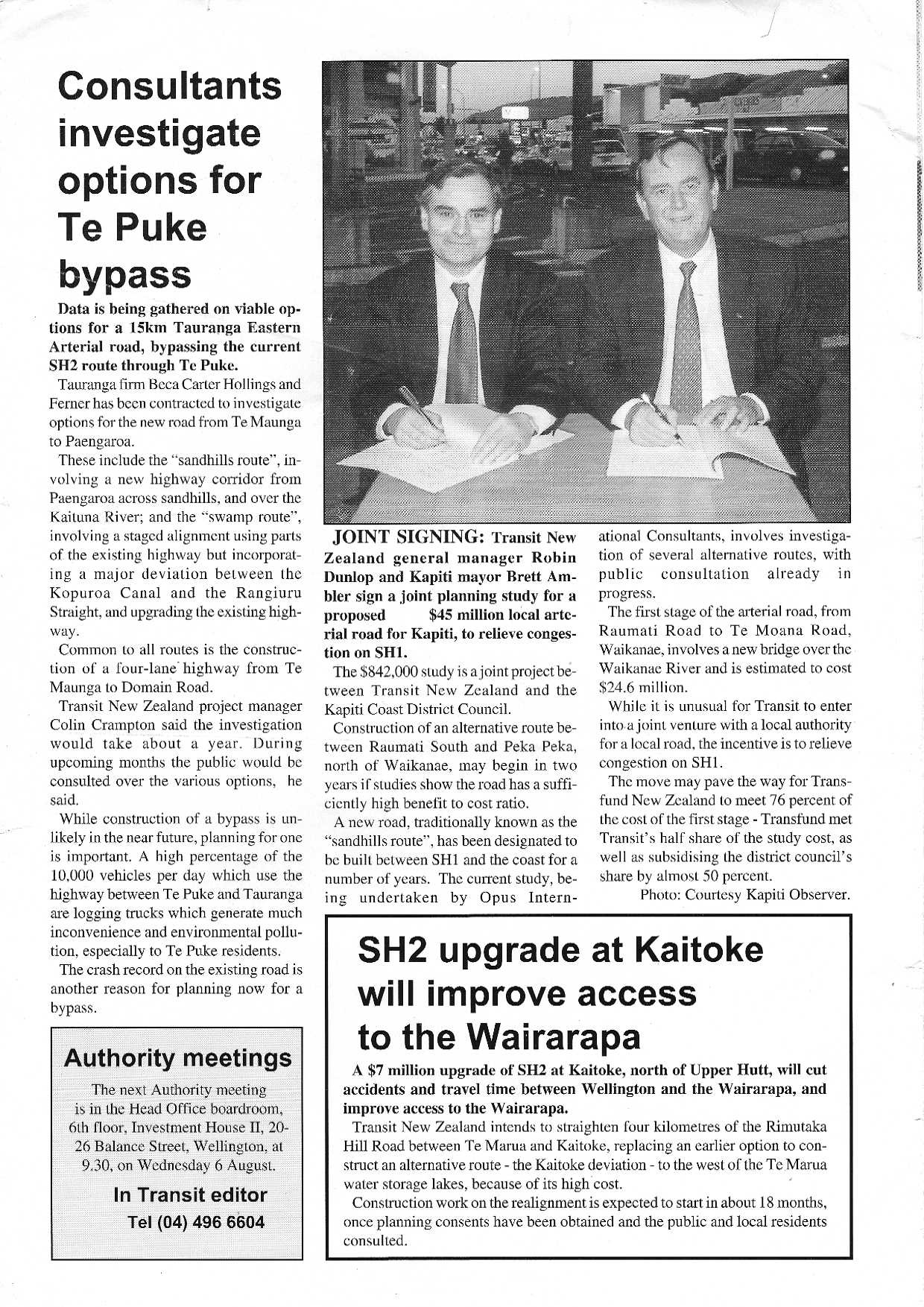
  • Options being investigated for the Te Puke Bypass (what is now the Tauranga Eastern Link) SH2.
  • Work to start on the $7m Kaitoke realignment on SH2 Wellington between Upper Hutt and the Remutakas.
  • Joint planning study launched with Kapiti Coast District Council for what was to be called the Kapiti Western Link Road project (a local road to connect Raumati, Paraparaumu and Waikanae to relieve SH1). This project was cancelled in favour of the Kapiti Expressway which was started in 2013 and completed in 2017, bypassing Paraparaumu and Waikanae with SH1.




18 September 2024

In Transit - February 1997 - No. 78 - Focus on repairs after Cyclones Fergus and Drena


In NZ, emergency works were always not too far away as part of the portfolio of works for road networks.  In February 1997, Cyclones Fergus and Drena caused extensive damage mainly in the Coromandel District.  The feature article highlights the cost of $5.8m (1997 prices) to fix the damage on SH25 and SH2, but also damage on SH1 (Brynderwyns), SH35 and SH88.

Other stories include:
  • Review of Special Purpose Roads: Special Purpose Roads were a category of local road that were subject to higher Financial Assistance Rate funding (typically 75%) from the National Roading Programme compared to other local roads (which obtain typically 50%). Such roads get higher funding because of a high proportion of tourist traffic, be below state highway standard and pass by properties with rating potential much lower than the costs of maintaining the road.  Curiously, this decision has mostly funding implications, yet was being carried out by Transit New Zealand which was no longer the funding agency, as Transfund New Zealand had been formed the previous year. 
  • Declaration of the revoked section of SH38 as a Special Purpose Road: As part of the State Highway Review in 1995, Transit New Zealand revoked SH38 between Te Whaiti and Ruatahuna. Transit announced it had decided to classify it as a Special Purpose Road increasing the funding to 75% of maintenance costs. That section of road was not sealed at the time. 
  • Earthquake strengthening of Thorndon Overbridge of the Wellington Urban Motorway: Image provided of the work to strengthen the 72 concrete columns supporting the Wellington Urban Motorway from the harbour over the Ferry Terminal, railway yards, Thorndon Quay. 
  • Briefing to the incoming Minister of Transport - Jenny Shipley indicates critical traffic levels in Auckland: This noted that traffic on Auckland Harbour Bridge had increased 20% between 1989 and 1997, and on the Northern Motorway south of Albany (when at this time it terminated), it had doubled from 1989 to 1995.  It noted work was underway investigating and consulting on various major projects included:
    • SH1 Albany-Puhoi (built in two stages)
    • SH1 Harbour Bridge approaches (subsequently cancelled in favour of the Victoria Park Tunnel)
    • SH18 Greenhithe Bypass (built as part of the Upper Harbour Motorway)
    • SH18 Hobsonville Bypass (built as part of the Upper Harbour Motorway)
    • SH20 extension to Richardson Road (built)
    • SH20 extension to SH1 south (built)
    • Bus only lanes on Northern Motorway (partially replaced with Northern Busway)
  • Transit NZ winning the Institution of Professional Engineers New Zealand (IPENZ) environmental award: For the upgrade of SH12 through Waipoua Forest.


30 November 2023

1996: National Roading Programme: Auckland/Northland NRP news

 The Auckland/Northland newsletter for the 1996 National Roading Programme of Transfund NZ.

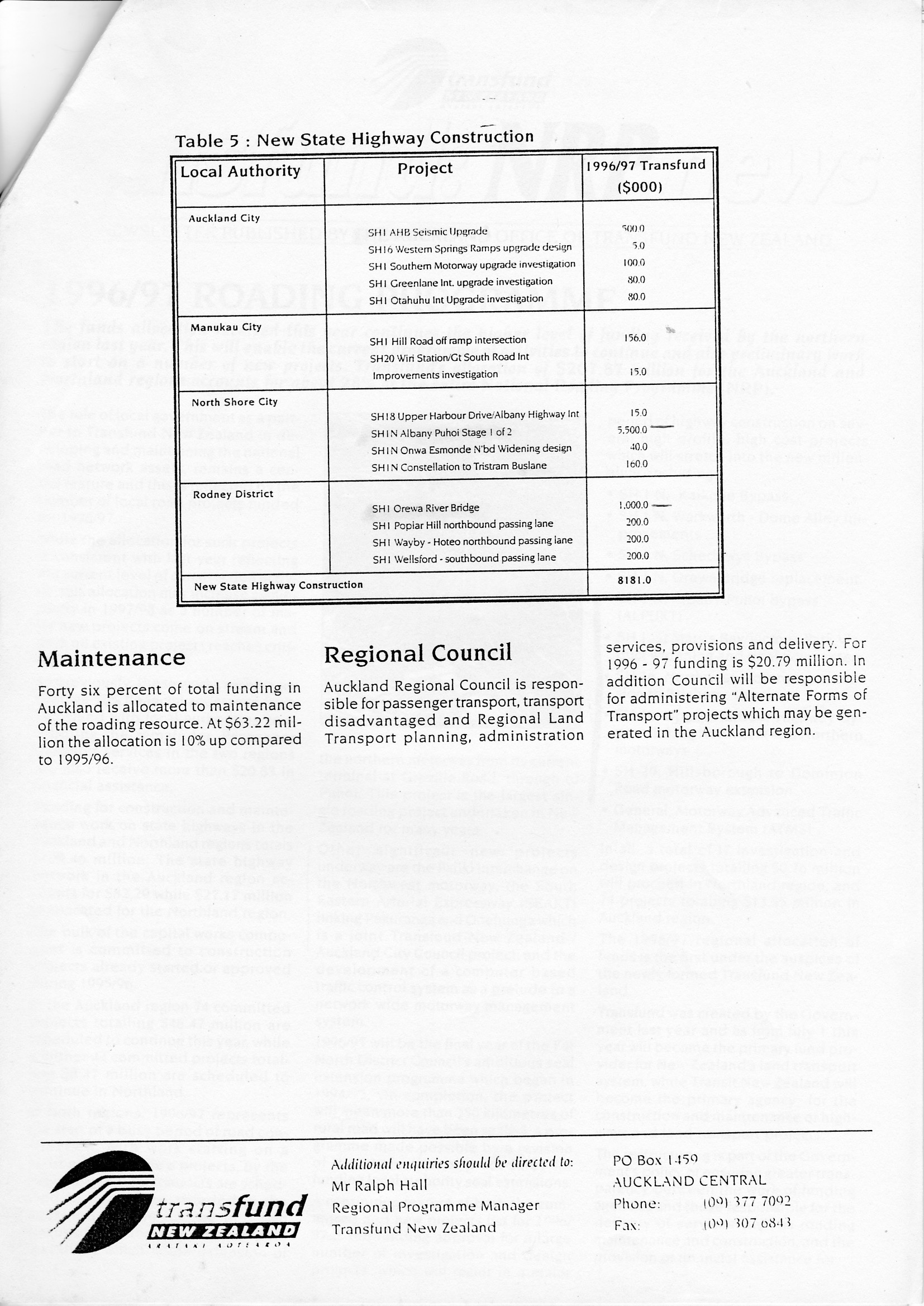
It was noted that 46% of spending in Auckland was road maintenance.  The newsletter has a comprehensive list of all state highway and local road projects funded, including investigation and design in Auckland and Northland. Notable in this NRP was approval of funding for the extension of the Northern Motorway from Albany to Silverdale, which continued to Orewa until funding to proceed was suspended in the early 2000s until tolling was authorised for the Orewa to Puhoi section. Investigation and design also began for a series of other major motorway projects in Auckland, including extensions of SH16 and the Upper Harbour Motorway SH18.

Major committed projects included:

  • SH16 Northwestern Motorway Rosebank and Patiki Rd Interchange construction
  • SH20 Southwestern Motorway extension Quarry Rd (Mangere Bridge) to Massey Rd (Papatoetoe), connecting the Mangere Bridge to the Pupatoetoe Bypass, and towards the Airport to George Bolt Memorial Drive
  • Auckland City Southeastern Arterial (Church Street-Mt Wellington-Pakuranga Motorway).

New construction projects included:

  • SH1 Northern Motorway extension Albany to Silverdale
  • SH1 Auckland Harbour Bridge seismic upgrade
  • SH1 Orewa Bridge replacement (pre Silverdale-Puhoi extension of Northern Motorway)
  • SH1 Puhoi-Wellsford passing lanes
  • 16km of seal extensions in Rodney District
  • Wairau Road intersection upgrades in North Shore
  • Thirteen seal extension projects in Far North District
  • Eight seal extension projects in Whangarei District

New investigation and design work was funded for future projects:

  • SH1 Warkworth-Dome Alley improvements
  • SH1 Schedewys Bypass
  • SH1 St Marys Bay/Victoria Park Viaduct widening/tidal flow (this did NOT proceed and was replaced by the Victoria Park Tunnel)
  • SH16 Northwestern Motorway Brighams Creek extension
  • SH18 Upper Harbour Motorway
  • SH20 Southwestern Motorway extension Hillsborough to Dominion Road
  • SH1 Southern Motorway Greenland Interchange upgrade
  • SH1 Southern Motorway Otahuhu Interchange upgrade
  • Auckland ATMS
  • Orewa Link Road to connect to Silverdale-Puhoi extension of Northern Motorway


Transfund NRP news Auckland Office pg1

Transfund NRP news Auckland Office pg2


Transfund NRP news Auckland Office pg3
Transfund NRP news Auckland Office pg4


Transfund NRP news Auckland Office pg5

Transfund NRP news Auckland Office pg6

Transfund NRP news Auckland Office pg7

Transfund NRP news Auckland Office pg8

16 August 2023

In Transit - September 1995 - Auckland Airport eastern access


In Transit September 1995 No. 67

Images of Auckland Airport eastern access bridge

Review of winter road closures, launch of state highway review

Quality Assurance in road markings

Stock effluent, London visitors discuss accessible transport

Black spot safety audits reduce crashes

This edition of In Transit highlights the Auckland Airport eastern access route which was under construction at the time (now SH20B).  The entire route cost $17m at the time and was due to finish in March 1996. The other most notable point was the benefits of black spot safety audits in reducing crashes, noting 2700 crashes had been prevented since 1985, as 61% of black spots identified had been upgraded with low cost solutions such as improved road markings, signs and lighting.

Other points in this edition are:
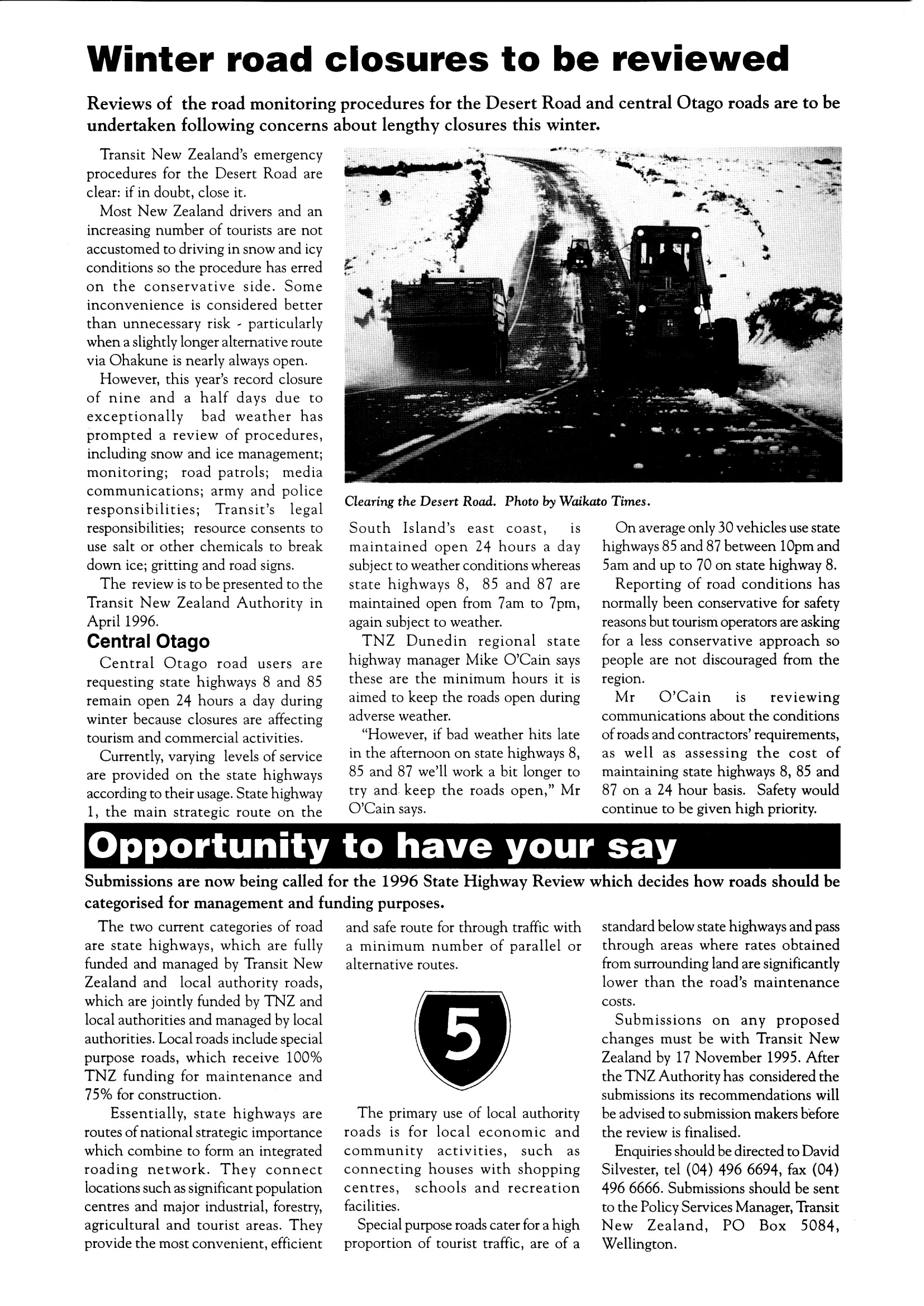
  • Review of the winter road closure policy for state highways
  • Launch of the State Highway Review (which reviewed which roads should become state highways and which should be cancelled as state highways)
  • Quality Assurance in road markings
  • First stock effluent disposal facilities trialled on two state highways
  • Visit by British accessible transport experts
  • Decision to construct slow vehicle lanes on both sides of SH29 Kaimai Ranges
  • Discussion of a private proposal to build the Te Puke Bypass, upgrade Pyes Pa Road and Route J. Ultimately Te Puke Bypass would become a state highway toll roads, Pyes Pa Road became a state highway and was upgraded, and Route J funded as part of the National Roads Programme.

03 August 2023

National Land Transport Programme 1996 - Auckland regional office


NLTP 1996 - Auckland regional information


NLTP 1996 - Auckland/Northland summary allocations

NLTP 1996 - Summary of regional allocation by output class for Auckland

NLTP 1996 - Auckland local road construction funding

NLTP 1996 - Auckland local road safety construction funding

NLTP 1996 - Auckland State highway safety construction

NLTP 1996 - Auckland State highway construction and passenger transport funding

In the final of the NLTP 1996 regional newsletter series, is Auckland, which had by far the greatest funding allocation.  $184 million was allocated for Auckland and Northland. This newsletter mostly focuses on Auckland.  Key Northland projects include completion of the sealing of SH12 through the Waipoua Forest and local road seal extensions.  The output classes with the greatest share of spending were state highways.

Key state highway projects were commitments to complete:
  • SH16 North-Western Motorway Rosebank interchange (providing eastbound off and on-ramps at Rosebank Peninsula)
  • SH16 North-Western Motorway Western Springs to Newton widening
  • SH20 South-Western Motorway extension connecting Mangere Bridge to the Papatoetoe Bypass and Kirkbride Road (to connect to George Bolt Memorial Drive)
  • SH1 Southern Motorway widening Papatoetoe-Manukau-Manurewa 6-laning
Largest local road projects were:
  • Auckland City's South East Arterial project (now the South Eastern Highway) from Church St to Pakuranga Bridge (a scaled down version of a planned motorway from the SH20 to Pakuranga and along the former south-eastern corridor.
  • Completing the sealing of former SH16 (which is now once again SH16) at Cleasby's Hill.
In addition are a number of intersection and local street upgrades to improve capacity and safety.

Notable was funding granted for design of notable major projects:
  • Albany-Puhoi extension to Northern Motorway, between Albany and Orewa (subsequently built)
  • SH20 Hillsborough Road to Dominion Road extension (subsequently built beyond to Mt Roskill)
  • SH1 Victoria Park widening (subsequently did not proceed but was replaced by the Victoria Park Tunnel)
  • SH1 High occupancy lane extensions in advance of the Northern Busway (between Esmonde Road and the Auckland Harbour Bridge)
  • SH1 Schedewys Hill Bypass (superseded by the Puhoi-Warkworth motorway)
  • SH1 Kawakawa Bypass (not yet built)
  • SH1 Kamo Bypass (subsequently built)

31 May 2023

In Transit March 1995 - No 61 - focus on bypasses


In Transit March 1995 No 61

Bypasses

Urlich Hill, Tar Hill, Catlins

Auckland south-eastern arterial etc

Bypasses

This edition ran a feature article on bypasses, highlighting the construction of the Pokeno bypass on SH1 being tendered (which would become essentially the top stage of the Waikato Expressway). The key point being how bypassing the town enabled reconstruction of its main road to suit local traffic and visitors, whereas some towns feared bypasses would mean the end of passing trade, Pokeno was welcoming it. 

The article continues to make some points about different towns and the conditions that determine whether or not a bypass might proceed such as whether existing roads are largely used vs. a new corridor (as the latter is more expensive it is less likely to be funded).  Levin and Stratford were cited as towns where it was too expensive to build a bypass as a new road would be needed.  Levin curiously was noted that 75% of southbound traffic and 66% of northbound traffic stops in Levin - given the current project to extend the Otaki Expressway to north of Levin (bypassing it), conditions have clearly changed somewhat.   Hikurangi and Mangonui in Northland have both benefited from bypasses, and it was noted that relocating SH1 away from downtown Hamilton had enabled the main street to be made more pedestrian friendly.  This reportedly increased city centre shopping.  

Wanganui was noted as having a motorway designation for a bypass, but this was considered unrealistic given traffic volumes, so a bypass close to the proposed route is proposed.  Ashburton was an interesting case study, in that SH1 was relocated onto a parallel road away from the town centre, but development occurred on the new route. This is considered suboptimal, because it simply means the new route becomes congested as well.  Transit NZ focused on bypasses providing safer and more efficient traffic flow.

Size of towns was important in considering bypasses, with Hamilton, Tauranga and Palmerston North having the main arterial running through them, able to stand on their own, but smaller towns regard through traffic as a lifeblood.  Timaru was noted as upgrading its main shopping street once its bypass is completed. Temuka likewise.  In Dunedin, SH88 was relocated away from Anzac Square/Dunedin Railway Station to make it more attractive for tourists, which was paid for fully by Dunedin City Council because it was a marginal disadvantage to motorists on the state highway. Progress was noted on designing bypasses for Motueka and Stoke, despite funding being considered marginal at this time. Finally, the bypass of Orewa (which ultimately became the Northern Gateway toll road) was noted as being as issue, because residents were concerned about the effect of the link road into Orewa (plus the original bypass designation was shelved, because Orewa's development mean the bypass would run between developments.

Other projects

  • Urlich Hill realignment in Northland was approved (a 1km project)
  • Mangaiti Hill deviation south of Tokoroa on SH1 had started (a 6 km project)
  • Funding for sealing 11km of the Catlins Road had been approved, with a remaining 32km left to be sealed.
  • Transit NZ has approved funding for Auckland City Council's South-Eastern Arterial project (with plans for it to be linked to Mangere Bridge in due course)
  • Strategy underway to ease congestion on Auckland's Northern corridor, by relieving bottlenecks on approaches to the Harbour Bridge, and developing a priority lane between Onewa Rd and Constellation Drive to encourage bus use and high occupancy vehicles. This would ultimately lead to construction of the Victoria Park Tunnel and the Northern Busway (although at the time the plan was for widening the Victoria Park viaduct). Note the expectation at the time was that the busway would be a high-occupancy vehicle lane.

29 May 2023

In Transit February 1995 - creation of a National Roads Fund and a separate land transport funding agency


Announcement of creation of a National Roads Fund

New structure for Transit NZ and SH6 Haast seal completion

Road toll down in 1994

Campaign about stock on roads and centralising traffic control in Auckland

Funding reform

The focus of this issue of In Transit is further reform of the road sector.  Legislation introduced (and subsequently passed) created a hypothecated roads fund and what would eventually become Transfund New Zealand, as a separate dedicated land transport funding agency. Albeit at the time of this newsletter, Transit NZ was hoping to avoid this. At this time, Transit NZ was both the state highway manager and the land transport funding agency, and did not wish to lose the latter function, which meant that it was responsible for decisions for funding itself, as well as funding local authorities for local road and passenger transport activities. Transit NZ's response to the reform was to set up a separate division, to deliver the funding function separate from its other activities, although it would all report to the same General Manager and Board. The Government of the day did not accept that this would be adequate separation between funder and provider.

The fund would mean revenue from road user charges, motor vehicle registration and licensing fees, and a specified portion of fuel excise duty would go into a National Roads Fund, which would determine the quantum of funds available to spend on land transport.  The reason for this was to ensure that growth in revenue from road users would be reflected in funding available for land transport infrastructure. Linked to this was the requirement to develop a national land transport strategy.

The reforms also saw provision made to continue previous introduced regional petrol taxes to support public transport funding (although not permanently). The new entity (not yet called Transfund) was at the time named as the New Zealand Roads Board, but in the interim a separate subsidiary entity would be set up in Transit NZ to undertake funding before it was completely separated.

Separating the funding and operational functions was seen as "improving Transit NZ's commercial transparency".  All of this was essentially reversed on 31 July 2008 when Transit NZ was merged into Land Transport New Zealand (which itself was a merger between Transfund NZ and the Land Transport Safety Authority in 2004), into the entity now known as Waka Kotahi/New Zealand Transport Agency. 

Other
  • SH6 Haast Pass sealing has been completed.
  • Road toll in 1994 was the lowest in 15 years at 581, attributed to increased speed enforcement and a major anti drink-drive campaign. Also noted was the safety audit programme reviewing the safety issues of potential projects. Crashes at black spots fell 35% in nine years. 
  • Concern farmers are not using stock movement signs adequately.
  • Investigation into what would be Auckland's Advanced Traffic Management System and centralised traffic control, with electronic signage that would later be introduced across Auckland's motorway network.

25 May 2023

In Transit No.57 October 1994 - forestry impacts on future road maintenance


In Transit October 1994 No. 57

In Transit October 1994 No. 57
In Transit October 1994 No.57

In Transit October 1994 No. 57

This issue highlighted challenges from growth in forestry traffic on both state highways and local roads, as Transit NZ had surveyed 18 local authorities expected to be most affected by growth in logging traffic. A 25% increase was expected over five years overall.  The key conclusion was that Transit NZ could fund the maintenance on its network and its share of local road maintenance, with the need being for local authorities to meet their share of funding their networks. 

Other key points in this issue:
  • Up to $7m of funding provided to Far North and Whangarei District Councils to both reseal and extend the length of seal on local roads in both districts (all of which have a BCR of 5 or over)
  • Discussion about the future of the old Mangere Bridge (which was ultimately dismantled and replaced with a new walking and cycling bridge which opened in 2022).
  • Western Australia learning from Transit NZ about addressing accident blackspots.
  • Design of the proposal for an alternative to the Wellington Urban Motorway extension, which was ultimately built as the Inner City Bypass Stage 2 (Karo Drive, new on-ramp and Vivian St one way eastbound).