Search This Blog

18 September 2024

In Transit - February 1997 - No. 78 - Focus on repairs after Cyclones Fergus and Drena


In NZ, emergency works were always not too far away as part of the portfolio of works for road networks.  In February 1997, Cyclones Fergus and Drena caused extensive damage mainly in the Coromandel District.  The feature article highlights the cost of $5.8m (1997 prices) to fix the damage on SH25 and SH2, but also damage on SH1 (Brynderwyns), SH35 and SH88.

Other stories include:
  • Review of Special Purpose Roads: Special Purpose Roads were a category of local road that were subject to higher Financial Assistance Rate funding (typically 75%) from the National Roading Programme compared to other local roads (which obtain typically 50%). Such roads get higher funding because of a high proportion of tourist traffic, be below state highway standard and pass by properties with rating potential much lower than the costs of maintaining the road.  Curiously, this decision has mostly funding implications, yet was being carried out by Transit New Zealand which was no longer the funding agency, as Transfund New Zealand had been formed the previous year. 
  • Declaration of the revoked section of SH38 as a Special Purpose Road: As part of the State Highway Review in 1995, Transit New Zealand revoked SH38 between Te Whaiti and Ruatahuna. Transit announced it had decided to classify it as a Special Purpose Road increasing the funding to 75% of maintenance costs. That section of road was not sealed at the time. 
  • Earthquake strengthening of Thorndon Overbridge of the Wellington Urban Motorway: Image provided of the work to strengthen the 72 concrete columns supporting the Wellington Urban Motorway from the harbour over the Ferry Terminal, railway yards, Thorndon Quay. 
  • Briefing to the incoming Minister of Transport - Jenny Shipley indicates critical traffic levels in Auckland: This noted that traffic on Auckland Harbour Bridge had increased 20% between 1989 and 1997, and on the Northern Motorway south of Albany (when at this time it terminated), it had doubled from 1989 to 1995.  It noted work was underway investigating and consulting on various major projects included:
    • SH1 Albany-Puhoi (built in two stages)
    • SH1 Harbour Bridge approaches (subsequently cancelled in favour of the Victoria Park Tunnel)
    • SH18 Greenhithe Bypass (built as part of the Upper Harbour Motorway)
    • SH18 Hobsonville Bypass (built as part of the Upper Harbour Motorway)
    • SH20 extension to Richardson Road (built)
    • SH20 extension to SH1 south (built)
    • Bus only lanes on Northern Motorway (partially replaced with Northern Busway)
  • Transit NZ winning the Institution of Professional Engineers New Zealand (IPENZ) environmental award: For the upgrade of SH12 through Waipoua Forest.


01 March 2024

2000: Clark Government seeks to improve funding for public transport

The 1999 General Election saw Labour win sufficient seats to form a coalition government with the Alliance Party, supported by the Green Party for confidence and supply.  The first Transport Minister under the Clark Government was Mark Gosche.  This article from the NZ Herald on 25 March 2000 reports on reforms he was proposing to change the mix of funding from Transfund New Zealand between roads and public transport. Key points from the article are:

  • Officials asked to review funding rules, this included lifting limits that had been placed on capital and operational spending for passenger transport, and reviewing cost/benefit criteria (the cap was removed).
  • The Northern Busway was expected to obtain funding following changes (not mentioned was a key issue as to what elements of the project were funded by Transfund vs. the three local government agencies relevant to the project).  (The Northern Busway was funded over the coming year.)
  • Negotiations between ARC and Tranz Rail (then privately owned for access to the track in Auckland for expansion of passenger rail services.  (ultimately this would result in the Clark Government buying the Auckland rail network from Tranz Rail for $81m, which was later superseded by nationalisation of the entire rail business).
The outcome of this work was ultimately the Land Transport Management Act, which enabled funding for public transport to be significantly expanded, but also the subsequent merging of Transfund with the Land Transport Safety Authority, and ultimately Transit New Zealand into the NZ Transport Agency.  


19 February 2024

Transfund News - November 1996 - No.3 - Working with local authorities and Alternatives to Roading

 The third edition of Transfund News in 1996 had no major focus, but included articles as follows:

  • Additional funding for territorial authorities to meet the costs of former State Highways that would be redesignated as local roads by Transit New Zealand under the latter's state highway review. The purpose being so that territorial authorities are able to more gradually absorb the local share of costs of roads that are no longer state highways, through other funding sources notably rates increases.
  • Development of Partnership Agreements between Transfund and road controlling authorities and regional councils, to formalise the funding arrangements between them.
  • Competition for construction contracts has been strong, with an average of 4.1 responses for each contract put out for tender by Transit NZ and territorial authorities for road physical works. It was noted that the Competitive Pricing Procedures in 1995 had resulted in a 10-15% reduction in state highway maintenance and construction costs.  Competitive tendering would continue to be rolled out so that by 1998 all minor and ancillary work would be put out to tender.
  • Local Authority Trading Enterprises (LATEs) won one in six local road physical works contracts in the first six months of 1996.  LATEs (now known as commercial Council Controlled Organisations) were the former local authority works departments that were required to be restructured into trading enterprises for local authorities to be able to receive central government funding for road works (this was intended to ensure a level-playing field between council and private contractors).  At the time, Manukau City, Waitomo District, New Plymouth District, Hastings District, Central Hawke's Bay District, Dunedin City and Clutha Districts had LATEs that won such contracts. 
  • Transfund released a discussion document called "Financial Assistance for Alternatives to Roading". It was split into public transport and freight ATRs. The purpose was to recognise that in the absence of road pricing, the land transport system would not be efficient if it only funded roads, if there was infrastructure or services that could be funded to make up the difference between user contribution and the net benefit of the project.  Two key constraints for ATR funding were significant. One was that funding was only available for projects that met the same benefit/cost ratio threshold as road projects that were being funded (in 1996 that was 4.5/1), another was that benefits were primarily benefits to road users as they were the ones paying for the project.
  • Concern about unsafe objects located around road networks, which Transfund can only provide guidelines and recommendations about.
Transfund News November 1996 No. 3 p1
Transfund News November 1996 No. 3 p2

Transfund News November 1996 No. 3 pg3

Transfund News November 1996 No. 3 pg4


01 February 2024

Transfund News - September 1996 - No. 2 - focus on new funding procedures

The second edition of Transfund News followed its first National Roading Programme and contained the following articles:

  • Release of Transfund's first Programme and Funding Manual listing all output classes, work categories and policy changes from when Transit NZ was the funding agency.  Key elements included incorporating safety fully into the capital works outputs, and for road maintenance to be  single output class across state highways and local roads. 
  • Launch of Transfund. Chairman Michael Gross noted that it "removed any potential conflict of interest" in funding.  It also included a dedicated roading fund (as it meant RUC and a portion of fuel excise duty would be hypothecated, and not reliant on the usual annual Budget process) for the first time, providing security of funding for capital and maintenance funding. Also noted was the ability to fund "efficient alternatives to roading". 
  • Removal of First Year Rate of Return as a funding criteria element, as increases in funding no longer rendered it necessary to ration project funding.  This was a measurement of the proportion of benefits a project would generate in its first year, compared to later years, as an additional element to determine whether a project which met the benefit/cost ration threshold had a higher priority for funding over others.
  • Contracts will be created between Transfund and Transit NZ, territorial authorities and regional councils for funding granted to them.  This reflects Transfund's role as purchase of services on behalf of road users and the desire to ensure good performance. 
  • Strong response to discussion paper on funding "efficient alternatives to roading", with final evaluation procedures to be decided at the end of the year.
  • Funding proposal procedures to be tightened.  This followed a report that indicated 34% of projects reviewed had significant shortcomings in their Benefit/Cost Ratio calculations.. Road controlling authorities are to be required to undertake peer reviews of their calculations. 
  • New software enables quicker calculation of benefits for projects that reduce accident costs

Transfund News September 1996 No.2 pg1
Transfund News September 1996 No.2 pg2

Transfund News September 1996 No.2 pg3


Transfund News September 1996 No.2 pg4


29 January 2024

Upper Hutt's River Road - a story of mismanagement causing death

In March 1987 Upper Hutt welcomed the long-awaited Upper Hutt bypass, which was quickly named as "River Road" to take SH2 away from the long, slow, traffic signal stopped drive through Silverstream, Heretaunga, Trentham, Wallaceville and Upper Hutt along Fergusson Drive, to a new fast route, at state highway speeds, following the Hutt River to Moonshine Rd, then crossing to the east side of the river to connect at Maoribank.  The road was one of the last major highway projects in the Wellington region commissioned by the National Roads Board (NRB), which was an arm of the Ministry of Works & Development (MWD).  In 1989 these functions would be transferred to a new Crown entity called Transit New Zealand, which would be state highway manager and land transport funder, and the MWD would be reformed into a state-owned enterprise, which would be later split and privatised in 1996. The motivation behind these reforms is a part of this story.

The new road not only saved considerable time for through traffic from the Wairarapa through to Lower Hutt and Wellington, but also better connected the western suburbs of Upper Hutt, and removed a great deal of heavy traffic from Fergusson Drive, where it interacted with pedestrians, cyclists and created safety hazards and generated pollution for the city.  Ultimately it opened up new areas for housing west of the river at what is now known as Riverstone Terraces.

However, the road was built at a deliberately low cost.  It had sign and traffic signal controlled intersections, rather than grade-separated ones.  The Moonshine Road intersection placed immediately north of the bridge was particularly poorly designed (and has since been relegated to having access to/from the highway southbound only).

Despite having a 100km/h limit, the new Moonshine Bridge was built to a 70 km/h design standard, creating an awkwardly tight bend for highway traffic around halfway along the route. It also was not built with any passing lanes, a problem which became clear soon after it was opened, as motorists complained about being stuck behind trucks, but also motorists who would stop along the route to sightsee or park by the river.  

The MWD had a solution. It did not have the funding (which at the time was part of the annual budgeting process of the Minister of Finance) to widen the road for passing lanes at the conventional highway lane width standard of 3.5 metres.  The road had been built with one 3.5 metre lane in each direction, and with sealed shoulders.  So it was decided as a quick fix, to fashion passing lanes between Silverstream and Moonshine Bridge within the pre-existing sealed carriageway, by removing the sealed shoulder so that an additional lane could be marked out.  This was done, but had several major problems:

  • The lane widths were narrowed to be 3m not 3.5m
  • The passing lane taper lengths were shorter than the usual standard
  • The speed limit remained the same
  • No median barriers, let alone painted median was installed.
The effect of building these narrow, short lanes, was devastating and a series of fatal accidents occurred over several months.  Seven people were killed in four accidents in four months.  The fatalities would continue. 

Ultimately funding was granted in the following year to widen the road so that the passing lanes were built to a proper standard, widened and lengthened.  Some years later a median barrier was installed.  It was notable that in 1988 the new Chair of the National Roads Board and Minister of Transport was also local MP, Bill Jefferies.  He would subsequently preside over reforms that meant he would not be involved in picking the projects to be funded, and to set up Transit New Zealand as a professional Crown agency a a dedicated state highway manager and land transport funder. In parallel, the MWD would be split and would have to compete with private contractors for state highway construction work. 

The clipping below highlight the celebrations on the opening of the bypass, and one article reporting the death toll and calls to upgrade the road.


24 January 2024

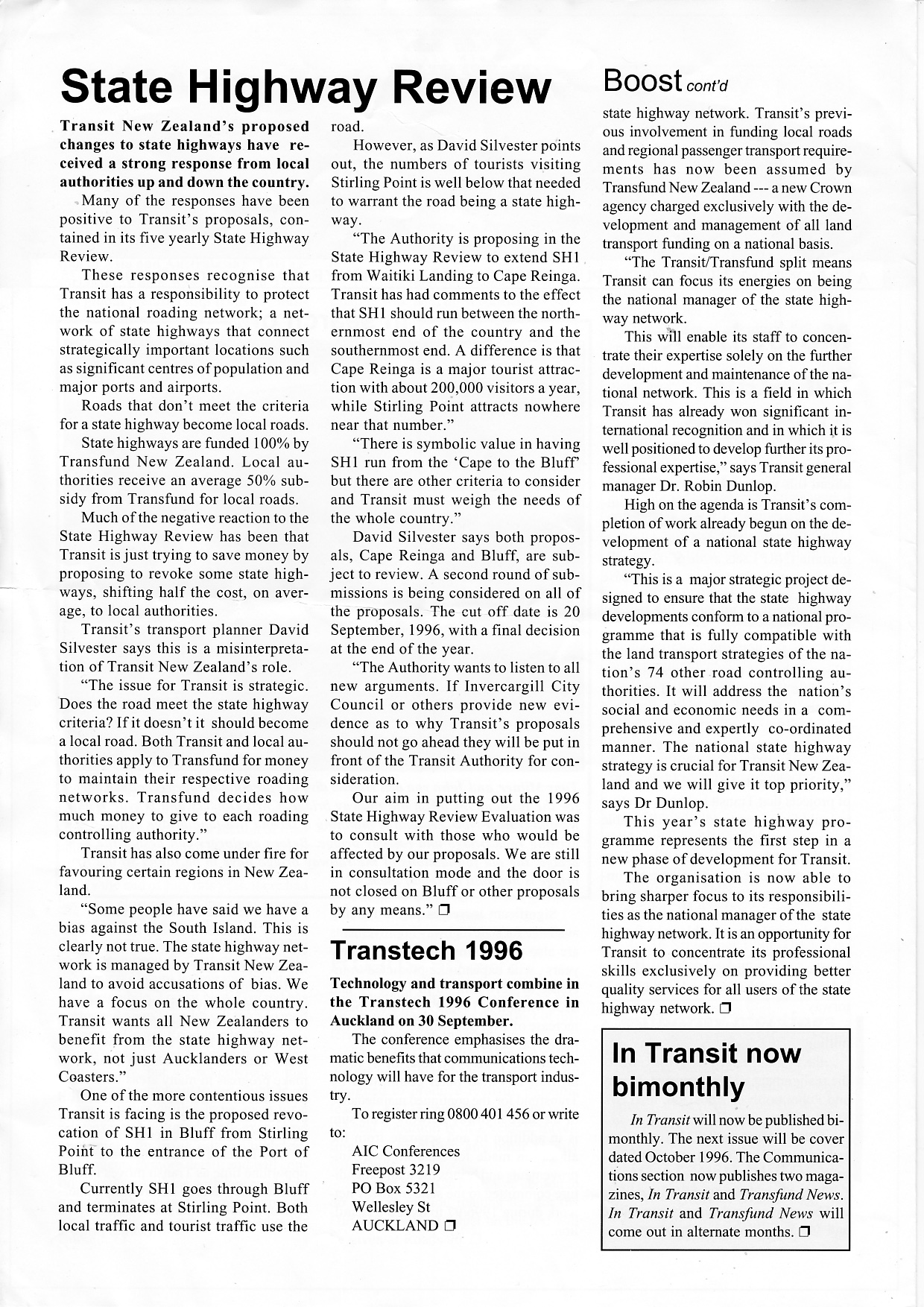
In Transit - August 1996 - No. 75 - 18% increase in state highway spending and Transfund separates from Transit

The August 1996 issue of In Transit is the first edition of the Transit NZ newsletter to be published after the agency's funding functions were transferred to Transfund NZ.  This issue focused primarily on the state highway funding provided by the 1996 National Roading Programme.  Key highlights of that were:

  • 18% increase in state highway funding compared to the previous year
  • New projects to be funded include:
    • Hastings extension of the 2-lane Napier-Hastings Motorway (bypassing Pakowhai to terminate on the outskirts of Hastings). This would later be redesignated as the "Hawke's Bay Expressway" and see SH2 relocated to this route.
    • Stoke Bypass SH6 Nelson
    • Albany-Silverdale extension to the Auckland Northern Motorway as the first stage of the ALPURT project
    • Otira Viaduct SH73 Canterbury to bypass the treacherous zig-zag section in Arthurs Pass
  • BCR threshold for project funding had been lowered from 5 to 4.5 and was expected to be 4 the following year
The newsletter also notes that the split between Transfund and Transit means "Transit can focus its energies on being the national manager of the state highway network". It was noted it would enable the agency to focus more on its professional expertise including development of a state highway strategy, so that the network was developed in a co-ordinated way.

Other points in the newsletter included:
  • Progress in the State Highway Review (which reviews which roads should or should not be State Highways). Noting that the Review proposed revoking State Highway status for SH1 from the entrance of the Port of Bluff to the southern tip due to the lack of tourist traffic
  • Colder weather explaining more closures of Desert Road (noting postponement of a trial of using road salt)
  • Various conferences
In Transit August 1996 p1
In Transit August 1996 p2
In Transit August 1996 p3

In Transit August 1996 p4

19 January 2024

1997: Interview with Transfund NZ Chair in Opus newsletter

In June/July 1997, Opus Consultants (the new name for Works Consultancy, the former Minister of Works and Development's consultancy arm after it had been privatised) produced its Momentum newsletter, which included an interview with then Transfund NZ Chairman Michael Gross.  The key points were:
  • Establishment of Transfund was central to a wider range of reforms of the roading system.
  • NZ's road network was seen as a model of change internationally by the World Bank
  • Setting up of Transfund is expected to make the system more efficient by assisting development and co-ordination of national and regional strategies.  It operates like a private company, with the security of revenue to develop long-term strategic solutions.
  • Gross said despite recent increases in funding (enabling the BCR for funding to drop to 4), the system is still underfunded.
  • NZ has a low capital/high maintenance road system meaning roads have relatively short lives, and Transfund is looking how to optimise this.
  • Alternatives to roading funding is to find ways to overcome the distortions of existing means of charging for road use, which doesn't address externalities such as congestion, environmental degradation and social dislocation.  Options it could fund include barging logs instead of massive road upgrades or new passenger transport systems to avoid building new road capacity, but is unlikely to provide funds for large projects like light rail.
  • The forthcoming Road Pricing Study is expected to document options for road pricing and the need for decisions.  Options include congestion charging, suggesting use of smart card technology, and replacement of rats with some form of access charge for properties to access the road corridor, with registration covering the right to use the network.
  • Gross thought a purely commercial model would be difficult to apply and need effort to ensure lightly trafficked rural roads were adequately funded, as urban areas generate far more income than the costs of maintaining those roads.
Momentum June/July 1997 - interview with Michael Gross