Search This Blog

10 October 2023

In Transit - June 1996 No. 74 - Quality Management

This edition of the InTransit newsletter focused on Transit New Zealand adopting the 1980s/1990s management trend of Total Quality Management (TQM). This was starting to go out of fashion in the United States at the time of this newsletter, as it was replaced with ISO9000 standards (mentioned in the primary article) and the Six Sigma approaches to management. 

Besides a description of how the agency adopted quality assurance, was an article celebrating the increase in the budget approved for Transit New Zealand enabling the BCR funding threshold to be lowered to 4.5 in 1996/1997 and 4 in 1997/1998, which reflected the Government's confidence in the standards of capital projects to be approved for funding by the new funding agency, Transfund New Zealand. 

Other elements of this newsletter are:

  • Description of the forthcoming Roads 96 conference including mention of the Land Transport Pricing Study, an epic piece of pioneering work to establish the costs including externalities, of land transport and the how these costs were paid or attributed;
  • Transit's interest in trialling an Advanced Traffic Management System (ATMS) for Auckland, which would subsequently be implemented.
  • Local authority survey of safety; and
  • An image of an on-street party celebrating the relocation of SH1 in Timaru from the CBD to the bypass route recently opened (which despite the caption is not a motorway). 

In Transit June 1996

In Transit June 1996

In Transit June 1996

In Transit June 1996

02 October 2023

Newlands Interchange, Wellington

Newlands Interchange - Project Newsletter 1996

It is taken for granted now by drivers and passengers using SH1 Ngauranga Gorge today, but it is notable that the last traffic light controlled intersection on SH1 north of Wellington until Papakowhai (and today until Levin) was not removed until 1998.

At the top of the Ngauranga Gorge on SH1 in Wellington, the Newlands intersection was a legacy of when the Gorge road was upgraded, sealed and widened in the 1930s as part of the Centennial Highway project (which ended in suburban Johnsonville and did not recommence until beyond Plimmerton to Pukerua Bay and along the coast to Paekakariki).  Having a traffic light controlled intersection on a six-lane highway that, at the time, operated at a 100 km/h speed limit, created a considerable bottleneck, primarily for the state highway traffic, but also long queues for traffic turning off to Newlands (which would back-up into the fast lane). Queues southbound would extend past the Johnsonville southbound offramp and northbound down to the Ngauranga intersection. Some of this is illustrated in the project newsletter. Contributing to congestion is that trucks from the quarry and industrial sites on the southern side of SH1 Ngauranga Gorge have to go uphill and enter Newlands, by crossing into the fast lane and queuing to turn.  This would be eliminated by the project having a slip lane to enter the interchange for an easier turn.

The intersection would also be the site for accidents ranging from multiple nose-to-tails to occasional red-light collisions.  One report indicated that the intersection had had 28 injury accidents in the five years from 1991-1996.

In essence, the efficiency and useful capacity of this section of highway was compromised by the intersection. Noting that by the time this project was built, two traffic light controlled intersections on SH1 in Porirua just north of the Johnsonville-Porirua Motorway (at Mungavin Avenue and The Ramp) had already been replaced by grade-separated interchanges, permanently relieving congestion on SH1 through Porirua. 

The Newlands Interchange project plans were released in 1993, but construction did not start until December 1996 and it was opened in March 1998. The problem was not funding, as it had a Benefit/Cost Ratio above 6. This consisted of $70m in travel time and vehicle operating cost savings over 25 years and $12m in accident savings over that time. At the time SH1 Ngauranga Gorge had around 60,000 vehicles per day with Newlands Roads at 13,000.  Today Ngauranga Gorge still averages around 59,000 vehicles per day.

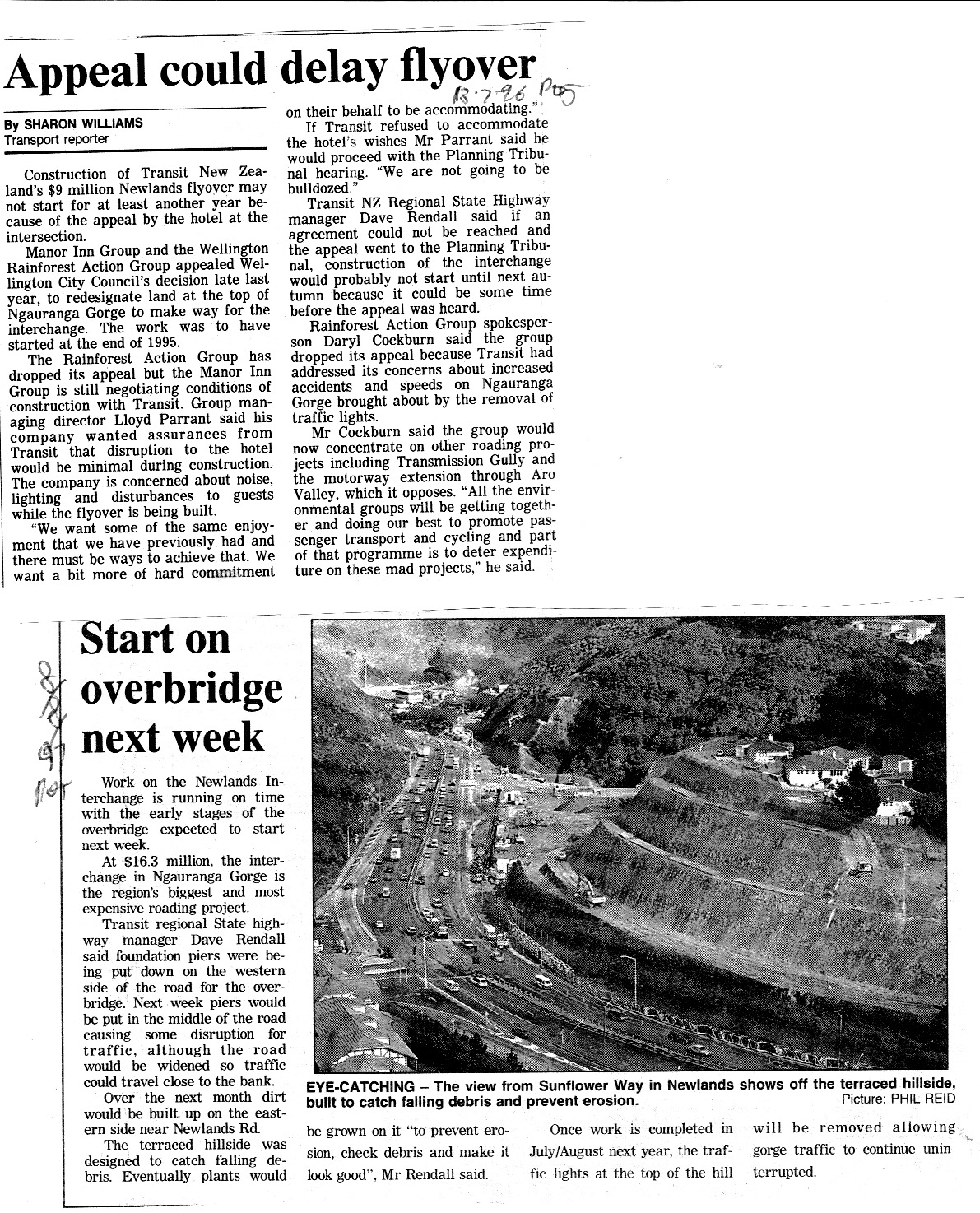
Delays were due to planning appeals, specifically local concerns about construction disruption from the adjacent motel and opposition from the Rainforest Action Group. This post includes multiple newspaper articles about the project, but also the official information leaflet upfront. 

The project was originally costed at $9m but ended up costing $16.3m (the BCR of over 6 reflect the latter cost, the previous cost had a BCR over 11)

Newlands Interchange - Project Newsletter Page 2

Newlands Interchange - Project Newsletter Page 3

Newlands Interchange - Project Newsletter Page 4


The following articles are :

  • dated 13 July 1996 from the Evening Post, about appeals for planning approval from the Manor Inn Group (largely due to concerns over disruption during construction) and the Rainforest Action Group (which withdrew its appeal). 
  • Dated 8 August 1997 depicting the construction of the project, including an image of how erosion and debris would be addressed.
  • Undated in 1997 also depicting construction of the project


1996 and 1997 articles

The following article reports on the final appeals against the project being addressed and intention to go to tender for its construction. 


Newlands interchange 04 October 1996 Evening Post

The following article is a schematic diagram of the project and describes further the problems with the former intersection.

Newlands Interchange 7 November 1996, Dominion

This final article reports on the interchange being due to open at the end of March 1998.

Newlands Interchange 19 March 1998 Evening Post


27 September 2023

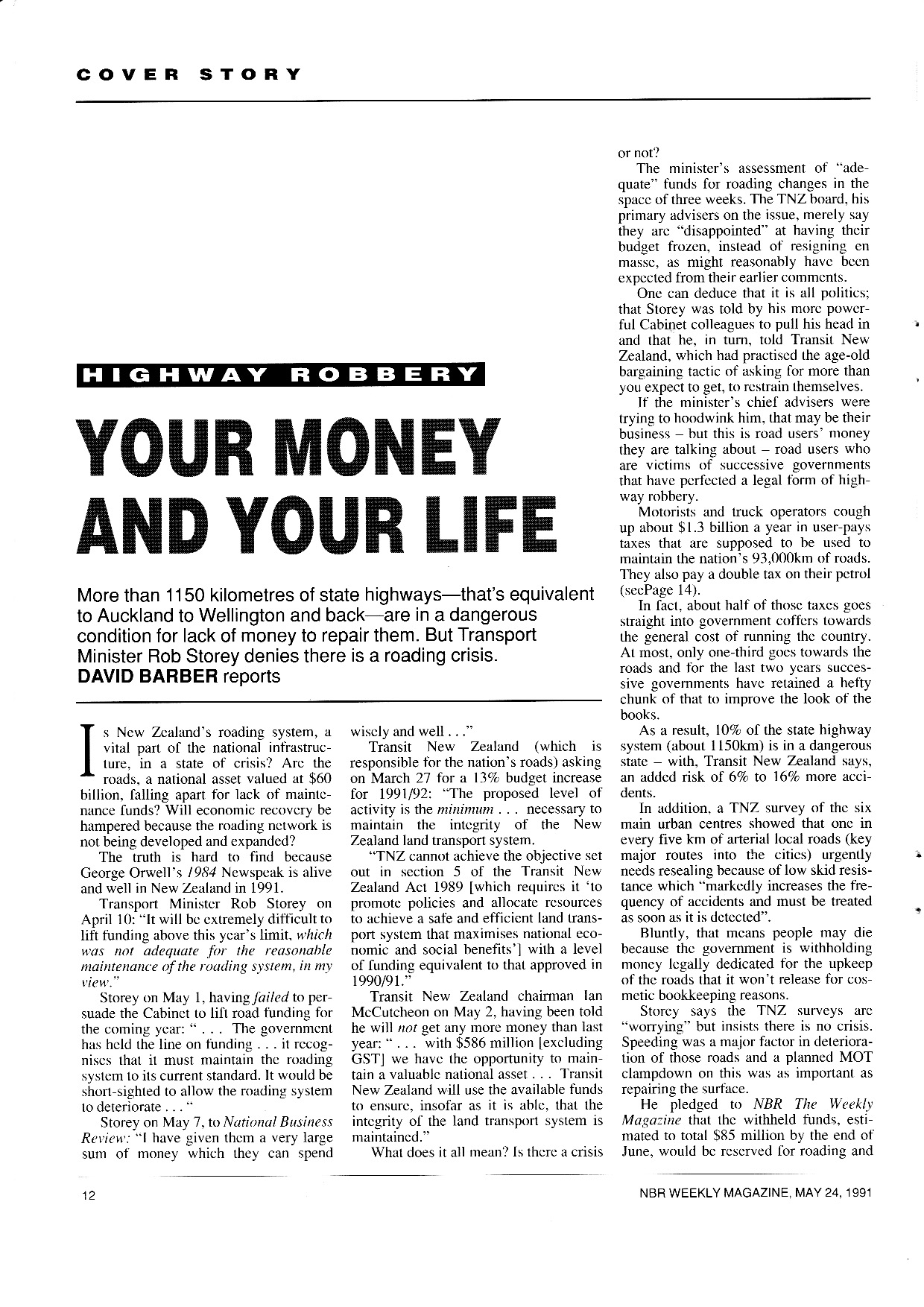
1991 : Is there a crisis in road funding?

This article from the National Business Review (NBR) Weekly Magazine in 1991 describes road funding at the time, and how the then Transport Minister Rob Storey had been unsuccessful in obtaining an increase in funding from the previous year.  The article focuses on how much revenue collected from road users is not spent on roads and the effects of tight levels of road spending at the time. 

At the time, funding was extremely tight for roads, with the previous year's budget for Transit New Zealand cut by 12%, and not being increased.  There was insufficient budget for all planned maintenance let alone significant capital spending, and the article was noting how many major capital projects looked unlikely to proceed in the foreseeable future.

Transit New Zealand was only approved the same level of funding for 1991/92 as it received in 1990/91, but it sought a 13% increase as being enough as the "minimum necessary" to maintain the system. In 1990/91 it had already had a cut in funding of 12% on the previous year, which had effectively ended new capital spending.  Spending increases were refused as Ministers figured that Transit New Zealand asked for more than it needed, and it was believed it ought to become more efficient. 

Although efficiencies were achieved, this was later noted as a mistake, which cost significantly more in additional capital spending due to the damage caused from deferred maintenance.

Key points in the article are:

  • Around half of revenue collected from road users is general revenue, and only a third goes on road spending (the remainder goes on public transport subsidies).
  • 10% of the state highway system is in a "dangerous" state.
  • One-fifth of the distance of arterial local roads urgently needs resealing because of low skid resistance. 
  • More funds would be released to Transit New Zealand if it proved it spent its approved budget well.
  • Transit New Zealand claimed the effect would be to snowball road deterioration that would cost more to repair (which was proven correct).
  • Excise duty at the time was $0.3097/l $0.109 of which went into the Land Transport Fund.
  • Transit New Zealand was funding projects with a BCR of 5.5 and above (for state highways) and 5 (for local roads) until 1991.
  • There was a $75m backlog of spending on bridge renewals.
  • Nearly civil works contractors went into receivership in the previous year.
  • Transit NZ General Manager says the roads won't fall to bits, but improvements won't happen.
  • Rough road surfaces are estimated to increase fuel consumption by 20% and vehicle repair costs by 40%
  • A single 200mm diameter pothole costs the economy around $6,000 p.a.
  • Minister Storey wanted a guaranteed minimum level of funding each year for Transit New Zealand.
  • Minister Storey was in favour of tolls to support new construction and to allow private companies to  set up their own toll roads.

Subsequently, reforms that required competitive tendering by local authorities for roadworks and the introduction of asset management requirements by Transit New Zealand generated significant efficiencies in road maintenance, so that governments in the 1990s increased funding for Transit New Zealand. It gained guaranteed approval of 97% of the previous year's budget, and funding was increased to enable consistent funding of capital projects with BCRs of 5 and above, until ultimately the separation of the funding function into Transfund in 1996.


22 September 2023

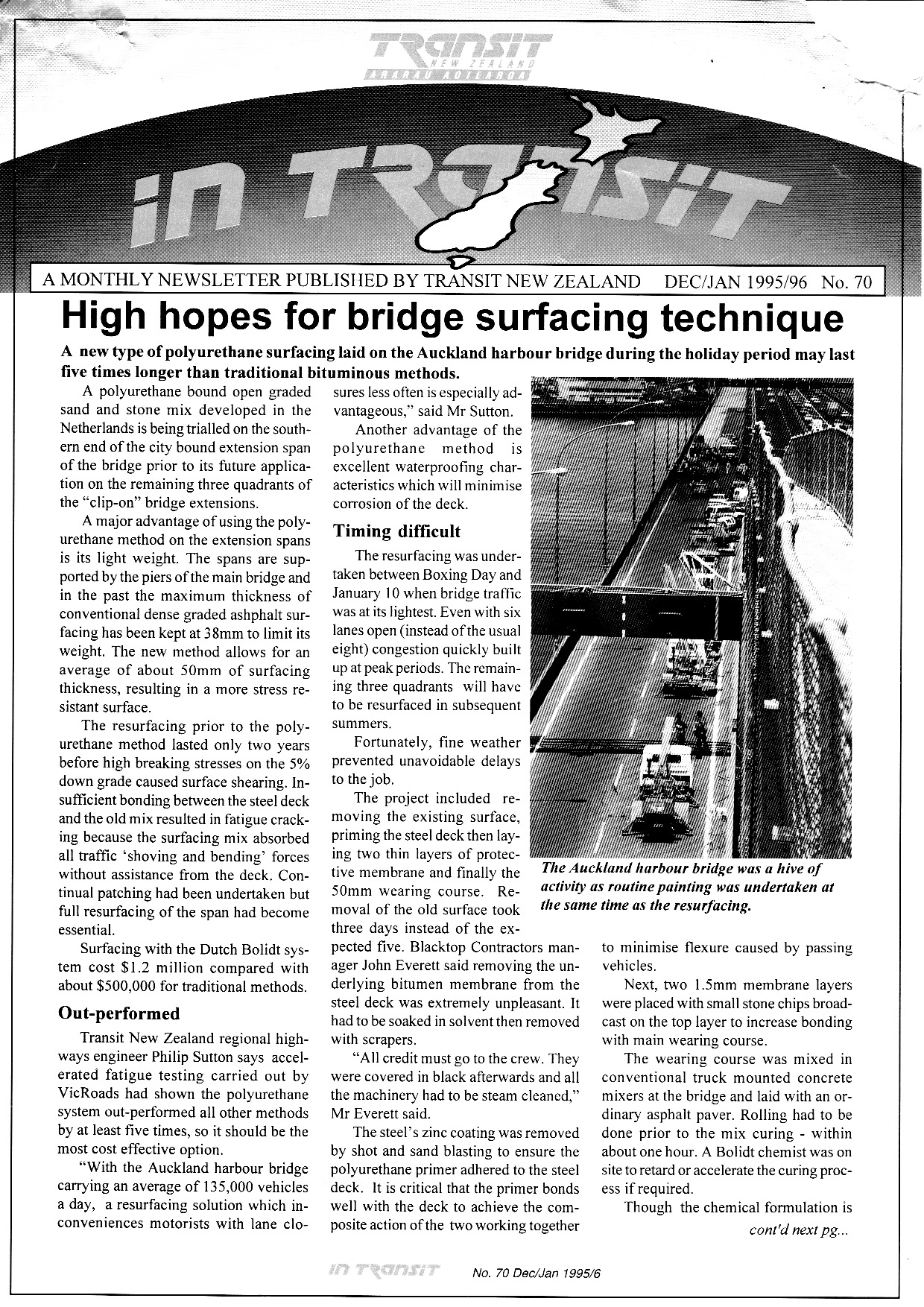
In Transit - December 1995 - Auckland Harbour Bridge Resurfacing trial


In Transit December 1995

Auckland Harbour Bridge resurfacing

Evaluation, PT competitive price procedures and road safety

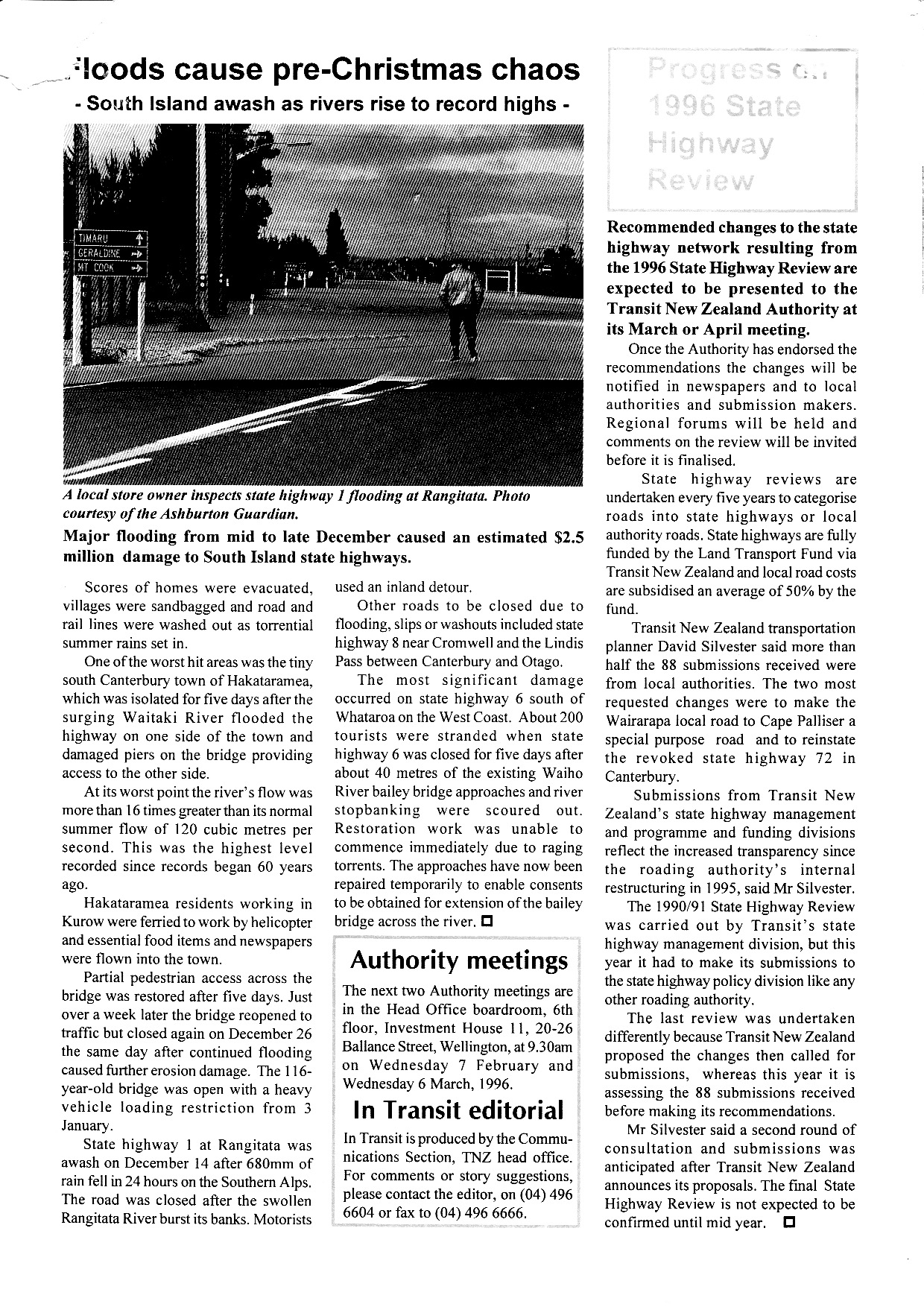
Flooding, State Highway Review

This end of year edition of InTransit has articles on:
  • New lighter, longer-lasting polyurethane surfacing trialled on Auckland Harbour Bridge may last five-times as long as conventional bitumen.
  • First Year Rate of Return (FYRR) to be used to support project evaluation. Projects with a higher FYRR to get priority over those that generate lower returns in the first year.  Expected to preference those with crash reduction benefits compared to those that reduce congestion.
  • Changes to Competitive Pricing Procedures for passenger transport contracts approved, enabling longer contracts (up to six years) and larger contract sizes (removing limits on seats per operator per route).
  • Need for a focus on driver behaviour to improve safety.
  • Flooding in South Island causing $2.5m in state highway damage.
  • Recommendations to be decided on State Highway Review.

20 September 2023

In Transit - November 1995 - International collaboration


In Transit November 1995 No. 69

In Transit November 1995 No.69


In Transit November 1995 No. 69

In Transit December 1995 No. 69

This edition of In Transit has articles on the following:
  • Technical collaboration between Transit New Zealand and AUSTROADS (the Australian association of road transport and traffic authorities) including use of the AUSTROADS pavement guide
  • Innovative new portable toilets to be trialled at rest areas north of Wellington
  • The National Roading Programme is to replace the National Land Transport Programme in 1996 when the funding functions of Transit New Zealand are transferred to the new Transfund New Zealand
  • Development of the Auckland Advanced Traffic Management System
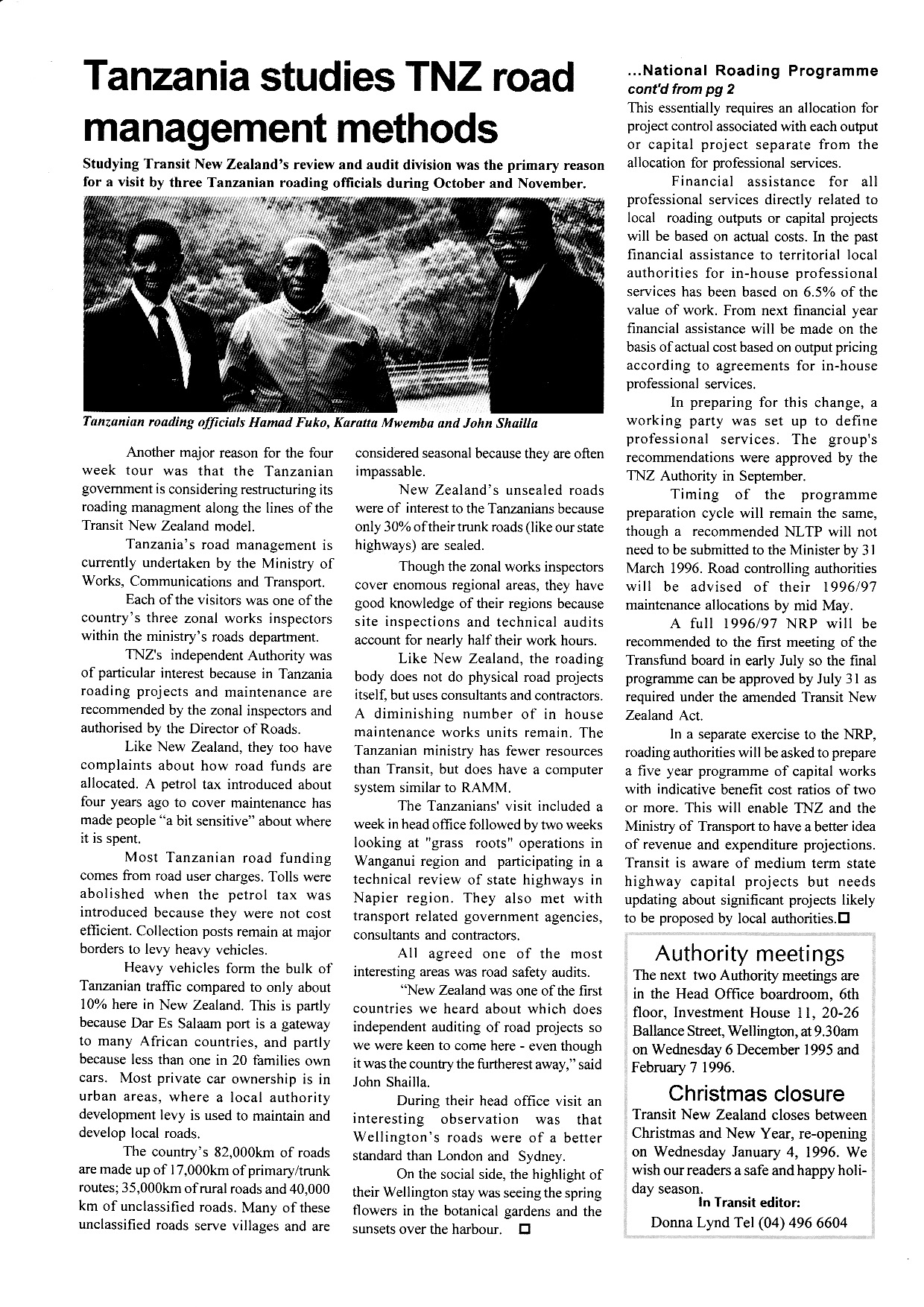
  • Tanzania studying road management in New Zealand.
It was noted that the launch of the National Roading Programme would see funding for all professional services at actual cost not 6.5% of the value of the capital work. It was also noted that roading authorities would need to prepare a five-year programme of capital works with indicative benefit/cost ratios of two or more, so that Transfund and the Ministry of Transport would have a better idea of revenue and expenditure projections. 

15 September 2023

Pukete Bridge opens


This page taken from one of the last issues of Works Consultancy's Momentum magazine reports on the design and opening of the Pukete Bridge in Hamilton City.  The bridge was opened to service the sprawling suburbs of Pukete, Chartwell and Flagstaff north of Hamilton, connecting to the R1 Arterial Road link, which itself linked Te Rapa, State Highway 1 (as it was then), across to a new north-south arterial to the east of Hamilton terminating at SH1 to the south of the city (now all bypassed by the Waikato Expressway).

The project included 1.5km of arterial road, a 150m bridge and related works.  The route was designed to support future four-laning along the whole route (the section from Resolution Drive to Te Rapa Road is now four-laned).  The project also included a 3m wide shared pedestrian/cycleway along the entire route physically separated from the arterial road. 

Works Consultancy at the date of this report was being sold to Kinta Kellas Plc as privatisation of the company. It was noted that the Works brand was bought by Downers for Works Civil Construction. 

11 September 2023

Land transport deregulation in AA Motor World

Motor World June/July 1983


Motor World June/July 1983


It's the June/July 1983 issue of the AA members' magazine, Motor World, and it's reporting on its cover page the deregulation of land transport, most specifically freight movement.  The Bill going through Parliament, during the final term of the Muldoon Administration, was to remove the distance limit on road freight competing with rail.  It would also remove the quantitative licensing system for road freight, intercity passenger coach services, rental cars and harbour ferries (based on applicants demonstrating sufficient demand for their business) to a qualitative based system, which would be based on meeting basic standards around experience, safety and financial capability.  The removal of the 150km limit was to occur gradually, with an exemption fee being able to be paid, until 1986 when there would be no need for such a licence at all.

The AA was concerned that it would result in the growth of larger, articulated trucks, on the state highways, making it more difficult and dangerous for car drivers to pass them.  Concern about how it would reduce the "pleasure and relaxation" of motoring was highlighted. Noting the effects of wind and noise, along with emissions.

It also claimed that the increase in truck traffic would require stronger pavements, road widening, more passing lanes, bridge strengthening and crawler lanes, and this should happen before deregulation.  The belief was that it was better to invest "now" rather than wait for future revenue from road user charges.  It called for heavy vehicle users to bear a higher proportion of the costs of maintaining the highway system.

The second report notes one canned food manufacturer estimated it would save $1.5m per annum (1983 dollars) if it could deliver from the factory to North Island markets by road.  However, the Road Transport Association (which represented the trucking industry) was highly wary of competition, no doubt because many of its members' business consisted of servicing railheads and providing short to medium delivery.  It said that rail should retain protection unless a road carrier could "prove" it could offer a better service.   

At the time it is worth noting the Ministry of Transport employed traffic officers who did both road safety enforcement and enforcement of transport licensing, so there was concern about how much effort traffic officers put into enforcing the 150km limit vs. enforcing safety rules. 

It was also noted that the Labour Opposition opposed the legislation and launched the "save rail" campaign, but ultimately did not overturn the reforms.  Indeed, it raised road user charges significantly during its first term in order to achieve better cost recovery of road maintenance expenditure from the trucking industry.

While not strictly about roads, this indicated a significant change in how New Zealand's roads were used, as well as heralding a dramatic change for the then New Zealand Railways Corporation, which would spend the subsequent years focusing on the parts of the domestic freight business it could be competitive in.